Presentation Design for Chiefs of Staff: The System Ownership Guide
The Chief of Staff's job in deck work is not authorship. It is system ownership. Build the templates, cadence, review cycle, and design partnership that keep recurring decks moving without you becoming the bottleneck.
The Chief of Staff's job in deck work is not authorship. It is system ownership.
That framing is counterintuitive to most Chiefs of Staff, who arrive at the role assuming their job is to write better decks, edit sharper decks, and generally improve the deck output of the exec team by putting more of themselves into every deliverable. That approach works for a quarter. Sometimes two. By quarter three, the CoS is buried in redlines at 11pm the night before every board meeting, the exec team is dependent on them for every polish pass, and the design quality of decks across the company still drifts, because one person cannot personally save every deck.
The alternative, which the best Chiefs of Staff arrive at within their first year, is to stop trying to write better decks and start building systems that produce better decks without them. Locked templates. Established cadences. Review cycles that catch problems early. A design partner who holds the visual bar. When the system is running, the CoS spends 20 percent of the time on decks they used to spend and the quality actually goes up.
This guide is about how to make that transition. It walks through what decks a CoS actually owns, the three modes of CoS deck ownership, the five decks a CoS should build systems for, how to build the system, the mistakes that keep Chiefs of Staff stuck in redline mode, and when it makes sense to bring in help.
Written for the Chief of Staff at a Series A to Series C company who owns some subset of the recurring exec deck cadence and wants to stop being the bottleneck.
What Decks Does a Chief of Staff Actually Own?
The exact scope varies by company, but at most growth-stage companies the CoS ends up owning some subset of the following:
- The quarterly board deck, either as author or as the person who assembles inputs from function leaders and does the final polish pass
- The monthly investor update, usually drafting from CEO input and executing assembly
- The CEO's all-hands or town hall deck, drafted from talking points, iterated with the CEO, and shipped
- Ad hoc CEO-requested decks, from board committee updates to investor breakfasts and strategic offsites
- Weekly or bi-weekly exec team meeting slides
- The quality-control layer for other exec team decks, keeping finance, product, and company updates consistent
This adds up. At a Series B company with a quarterly board cadence, a monthly all-hands, a monthly investor update, and a busy exec team, a CoS in author mode can easily spend forty percent of their week on deck work. That is not a strategic allocation of time for someone whose actual job is to make the exec team run better.
Reducing that number from forty percent to ten percent, without dropping quality, is the point of everything that follows.
What Are the Three Modes of Chief of Staff Deck Ownership?
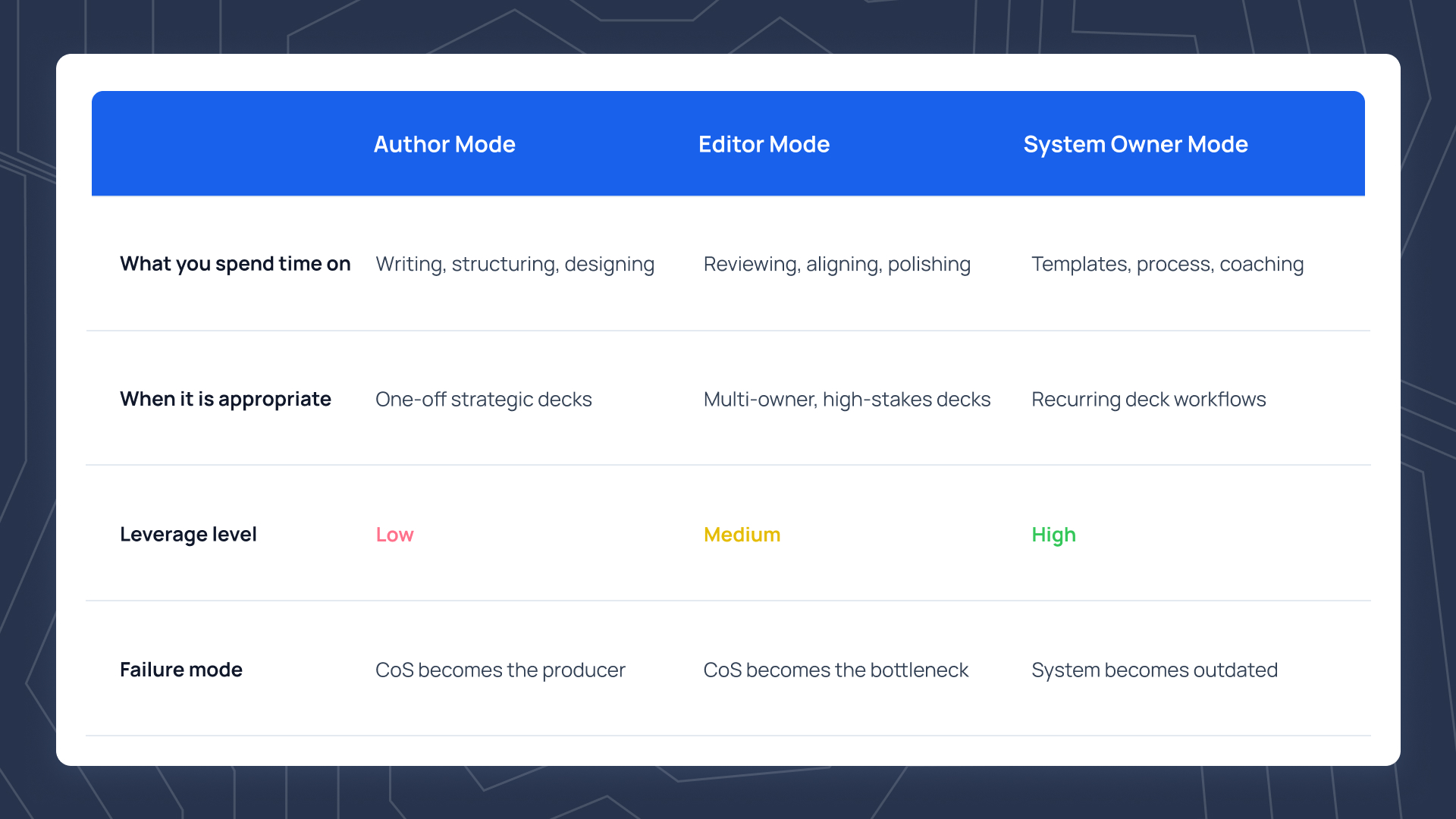
Chiefs of Staff show up to deck work in one of three modes. Understanding which mode you are in for each deck is the first step to changing the allocation.
Author mode
You write the deck end to end. Structure, content, slides, design polish, all yours. Author mode is appropriate for one-off strategic decks where the CoS genuinely has the deepest context, such as an offsite deck, a strategic memo turned into slides, or a special-purpose ask. It is the wrong mode for recurring artifacts, because it does not scale and makes the deck dependent on the CoS being present.
Editor mode
You review drafts from other function leaders, harmonize voice and design, and do a final quality pass before the deck ships. Editor mode is appropriate for board decks and investor updates at Series B and beyond, where multiple function leaders contribute and the CoS is the last line of quality control. It is the wrong mode when the CoS is the only person editing every deck; that is a bottleneck, not a workflow.
System owner mode
You own the templates, cadence, review cycle, and design partner relationship that produce high-quality decks without your day-to-day involvement in every one. You spend time on the meta-work: keeping the template current, reviewing what is and is not working each quarter, and coaching function leaders on how to use the system. System owner mode is the highest-leverage mode, and the one most Chiefs of Staff never fully move into because it feels less like doing the work.
Why Does System Ownership Beat Authorship?
- 1It is the only mode that scalesA Chief of Staff in author mode has hard limits on how many decks they can personally produce, and quality degrades as volume grows. Editor mode raises the limit slightly but still bottlenecks the company on one person's calendar. System owner mode produces high-quality decks from every function because the system enforces quality on the CoS's behalf.
- 2It is the only mode that survives your absenceA CoS who authors every important deck becomes indispensable in an unhealthy way. Vacations make decks slip, and departures take months of institutional knowledge with them. A well-built system keeps producing because templates, cadence, and quality gates hold without one person.
- 3It is what a strategic Chief of Staff actually doesThe role at its best makes the executive team run better across strategy, operations, communication, hiring, and decisions. Every hour spent authoring a slide is an hour not spent on those higher-leverage activities. System ownership is what frees the time.
Which Five Decks Should a Chief of Staff Build Systems For?
Not every deck a CoS touches needs a full system. The following five ship on repeating cadences and consume enough time in aggregate that systematizing them is the single highest-ROI move a Chief of Staff can make in their first year.
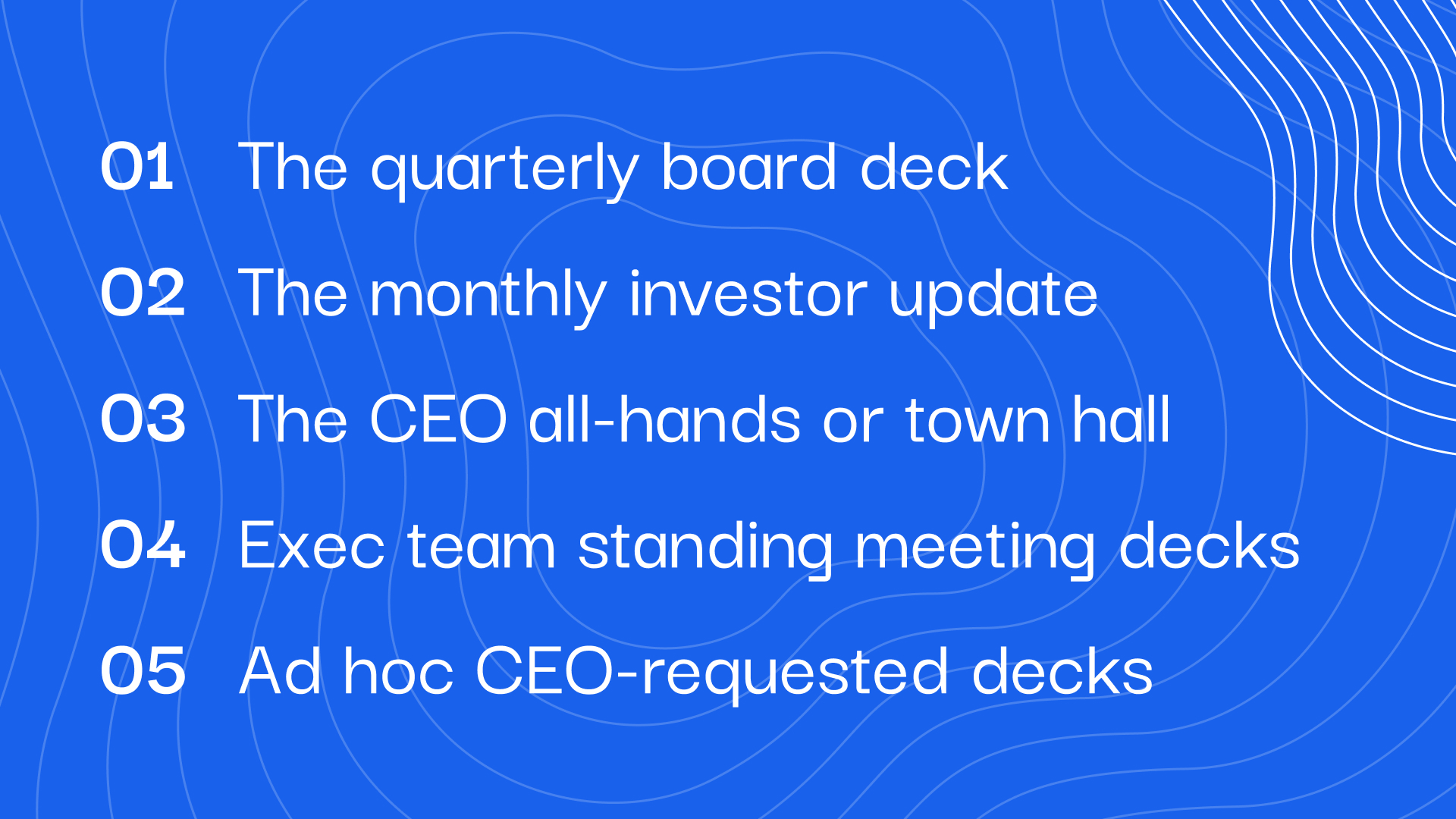
1. The quarterly board deck
The most important artifact you own, and the one most Chiefs of Staff burn the most time on when it is not systematized. The system: a locked template that stays the same every quarter, standing metric slides that pull from a data source, function-leader ownership of sections with clear deadlines, and a two-week assembly cadence that runs like clockwork. Once built, it should take fifteen to twenty CoS hours instead of forty. See our full guide on how to build a board deck for the underlying structure.
2. The monthly investor update
Twelve sends per year to the same audience. The system: a locked template, a fixed send day, a standing metric section that pulls from your BI tool, and a two-hour writing block for the narrative slides. The CoS drafts, the CEO reviews, and both sign off within twenty-four hours. When it is working, the update takes three to four CoS hours per month instead of eight to twelve. See the guide on how to write an investor update for structure specifics.
3. The CEO all-hands or town hall
Monthly at Series B and above, sometimes quarterly. The system: a recurring slide skeleton covering agenda, business update, wins, priorities, and Q&A prompts; a design template that matches the internal brand; and enough visual pacing to hold employee attention for thirty to forty-five minutes. The all-hands deck should not be a two-week project every month. If it is, the system has not been built yet.
4. Exec team standing meeting decks
Weekly or bi-weekly slides for the exec team meeting itself. They are often overlooked because they feel casual, but an exec team that meets weekly ships fifty of these decks a year. The system: a lightweight template with CEO priorities, function-by-function status, an OKR update, and a decision queue, owned by function leaders with the CoS as light editor. It should not consume meaningful CoS time once the template is running.
5. Ad hoc CEO-requested decks
The category that resists systematization: a board committee update, investor breakfast, strategic offsite, or partner meeting. Each is one-off, but they come up constantly. The system: a starter template with the brand skeleton, a modular slide library the CoS can pull from, and a norm that every ad hoc deck follows the same underlying template rather than starting blank. This drops per-request build time from six hours to two.
How Do You Build a Chief of Staff Deck System?
A working CoS deck system has four components. Missing any one of them and the system leaks.
1. A locked master template
Use one template across every recurring deck the CoS owns: the same fonts, color palette, chart styles, and slide layouts. The template is owned by the design function, CMO, or design subscription partner and updated once a year during the brand review. Individual decks are assembled from approved modular slides, never from a blank slide. The underlying slide design principles should be explicit enough that every contributor can follow them.
2. A cadence calendar
Create a single calendar view of every recurring deck due date across the year: board decks, investor updates, all-hands, quarterly reviews, and offsites. Each deck gets a defined assembly window with milestones for content deadlines, design review, and executive sign-off. The calendar makes the workflow visible and protects time for assembly instead of forcing the CoS to do it at the last minute.
3. A quality gate before ship
Define a checklist every deck must pass. Does every slide have a full-sentence takeaway title? Do charts follow the design system? Is the appendix populated? Is the visual template unchanged from last quarter? For the chart layer, use the same standards covered in our guide to data visualization for board decks. The gate makes review objective instead of dependent on the CoS's mood and available time.
4. A design partner who holds the visual bar
Give one person or partner ownership of the template, its scheduled refresh, the higher-polish work, and the authority to push back when function leaders freelance the design. That owner might be a design lead, an in-house designer, or a design subscription. Without the role, the template drifts within two quarters no matter how well it was built.
Which Mistakes Keep Chiefs of Staff Stuck in Redline Mode?
Six patterns keep CoS deck work chaotic. Every one is a version of trying to solve system problems with individual effort.
- 1Rewriting drafts instead of coaching function leadersEvery rewrite reinforces the pattern that the CoS is the author. Send drafts back with structured feedback the first three times. By the fourth quarter, function leaders should be shipping publish-ready drafts.
- 2Working from a new blank slide each timeEvery deck built from scratch looks slightly different from the last one. Start from the template every time. If it needs updating, update it during the annual refresh, not inside an individual deck.
- 3Skipping the assembly calendarThe board deck due in ten days cannot live under an informal promise to get to it next week. Put a hard calendar block around every recurring deck at the start of the quarter.
- 4Doing the design work yourselfA CoS spending three hours at midnight fine-tuning slide alignment is doing work that belongs to a designer or subscription. Hand off design polish to a design partner, always.
- 5Being the last reviewer with no quality gateEvery deck lands on the CoS's desk for a subjective review that changes with time and workload. Replace it with a defined pre-ship checklist anyone can run, so the CoS is not the bottleneck.
- 6Underinvesting in the executive presentation systemThe CEO all-hands and quarterly board deck are among the most scrutinized surfaces in the company. Treat executive presentation design as core infrastructure, not overhead.
If you are deciding who should own the polish work, read the honest math on subscription vs in-house design and the broader guide to executive presentation design.
When Should a Chief of Staff Bring In Help?
Most Chiefs of Staff move to system-owner mode later than they should, because bringing in help feels like an admission that they cannot handle the work. It is the opposite: it is what lets the work scale. Paul Cohen's Chief of Staff Guide is a useful wider reference on shaping the Chief of Staff role around leverage rather than task volume.
- You are polishing decks after 8pm more than once a weekThat is not sustainable at any stage, and it means the system has not caught up with the volume. Bring in a design partner or hire and hand off the polish work.
- Exec team decks are drifting visuallyDifferent fonts, color palettes, and chart styles across finance, product, board, and all-hands updates point to a design-system problem. Fix it with a single owner enforcing consistency.
- Less than 40 percent of your calendar is unstructured strategic timeIf deck work is eating your week, you have moved from Chief of Staff to Chief of Slides. Neither the company nor your career is served by that trajectory. Bring in help.
For most growth-stage companies, the right answer is a monthly design subscription that owns the template, executes the polish work on recurring decks, and pushes back when function leaders try to freelance. This is exactly what Slidecore does.
Own the system, not the redlines.
Slidecore is a monthly design subscription for growth-stage teams shipping board decks, investor updates, and executive presentations on a recurring cadence. Locked template, senior designers on your account, and a first draft within 24 hours. Built for Chiefs of Staff who want to stop being the deck bottleneck.
Frequently Asked Questions
The quarterly board deck, monthly investor update, CEO all-hands or town hall, ad hoc CEO-requested decks, exec team standing meeting decks, and the quality-control layer for other exec team decks. Exact scope varies, but at growth-stage companies a CoS in author mode can spend forty percent of their week on deck work if the system is not built out.
The Chief of Staff owns assembly, the design system, and quality control. The CEO owns the narrative: the executive summary, wins-and-misses framing, strategic priorities, and asks. Function leaders own the numbers for their functions. This split scales without turning either the CEO or CoS into the bottleneck.
At Series B and above, a well-systematized Chief of Staff should spend roughly ten to fifteen percent of their week on deck work in normal weeks, spiking to thirty percent in the two weeks around a board meeting. If it is consistently above twenty-five percent, work should move to templates, function leaders, or a design partner.
Authoring means writing the deck end to end. System-owning means building the templates, cadence, review cycle, and design partner relationship that produce high-quality decks without day-to-day involvement in every one. Authoring is the default mode; system ownership is the mode that scales and survives your absence.
Three signals: you personally polish decks after 8pm more than one night a week, exec team decks are visually inconsistent across functions or quarters, or less than 40 percent of your calendar is unstructured strategic time. Any one means deck work has become a bottleneck.
Trying to be the author instead of the system owner. It works for a quarter or two, then the CoS is buried in redlines and quality still drifts. The fix is a locked template, cadence calendar, quality gate, and design partner that produce high-quality decks without CoS involvement in most of them.
Run three tests: does the deck ship predictably, does it take fifteen to twenty CoS hours rather than forty-plus, and does it remain structurally consistent from quarter to quarter? Failing any of the three means the system needs work.

Founder, Slidecore
Giorgi founded Slidecore to give teams a senior design partner for decks. His teams have designed 500+ decks for 100+ companies across SaaS, AI, fintech, and healthcare.
Meet the founder →Want decks like this for your team?
A design studio on subscription for every deck, report and keynote you ship.