Presentation Design for Head of Marketing: Building a Deck Production System That Scales
A field guide for Heads and VPs of Marketing who have realized that the deck problem is actually an operating-model problem.
If you run marketing at a growth-stage company, you spend more time thinking about decks than you probably want to admit. For the vendor shortlist that complements this production-system guide, see our top 10 deck design agencies and subscriptions roundup.
Every quarter has a board deck. Every month has an investor update that needs charts and polish. Every major sales cycle wants a tailored pitch. Every launch needs a narrative deck. Every all-hands needs slides. Every analyst briefing, every customer QBR, every executive offsite - all of it ultimately ships as a presentation that someone on your team spent too many nights on.
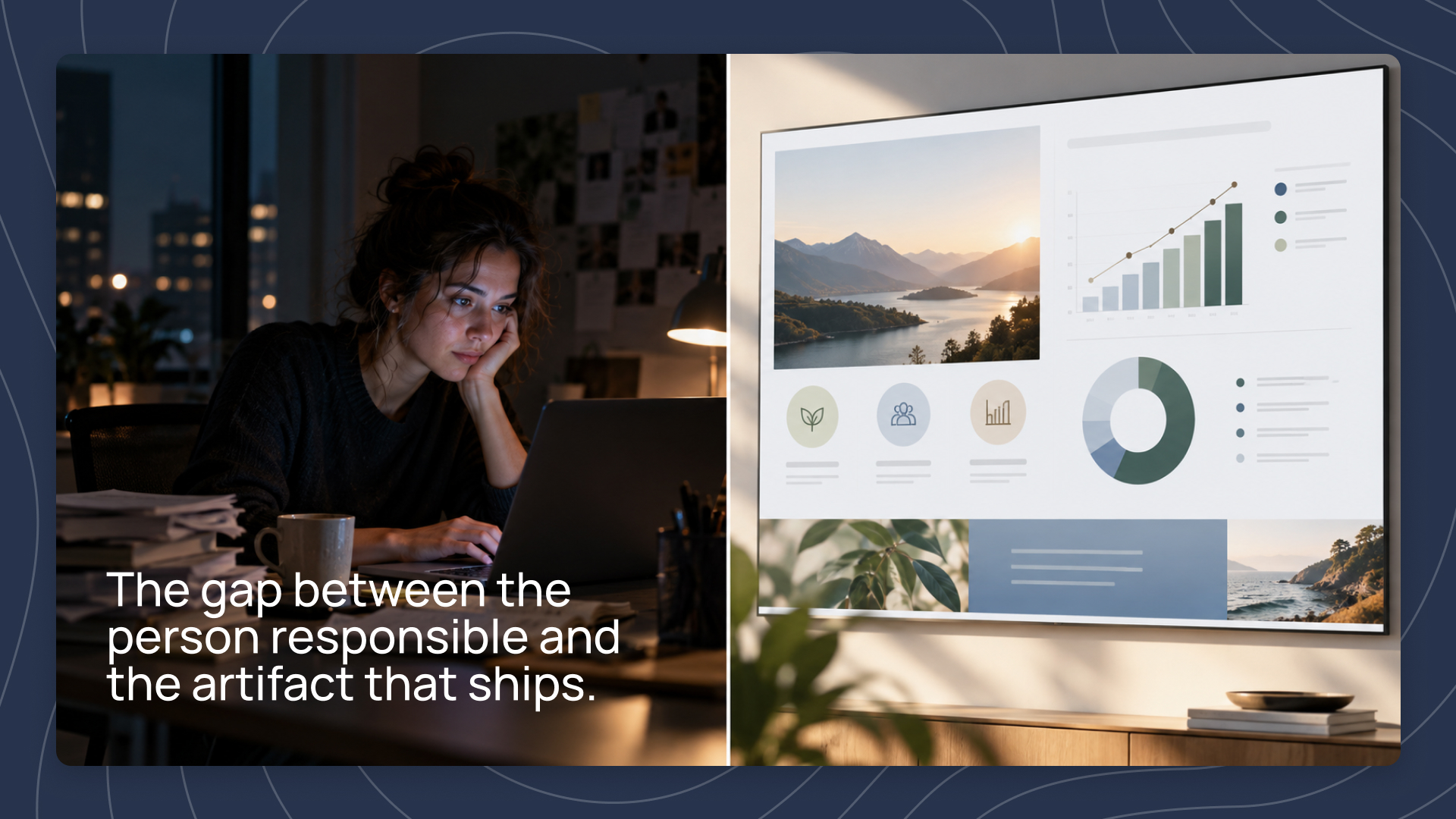
The deck problem gets described inside marketing orgs as a design problem. It usually isn't. It is an operating-model problem - a question of how deck production is structured, who owns strategy versus execution, and what capacity exists to absorb the recurring workload without burning out your best people on PowerPoint.
This guide is for Heads and VPs of Marketing navigating that transition - from "we make our decks somehow" to "we have a system that produces decks reliably." It covers the shape of deck demand at growth stage, the production models most teams try (and the failure modes of each), and how to build a system that scales without hiring your way out of the problem.
The shape of deck demand at growth stage
A specific pattern shows up at Series B and continues through Series D. Deck volume grows faster than marketing headcount can absorb, and the mix of deck types broadens at the same time.
A typical growth-stage marketing team ships:
- One board deck per quarter (strategic, prepared by Head of Marketing with CoS)
- One monthly investor update (shorter, data-heavy, often templated)
- 2-4 major sales decks per quarter for enterprise prospects (tailored, high-stakes)
- 1-2 product launch narrative decks per year (positioning, press, analyst briefings)
- Weekly or biweekly all-hands slides (internal, lightweight, high-volume)
- Analyst briefing decks (quarterly, polished, often restricted-distribution)
- Executive presentation decks for conferences and keynotes (2-6 per year)
- Reports: annual, quarterly, benchmark studies (often one or two major per year)
Count the slides. For a 200-person company at Series C, this is routinely 300-500 slides of designed output per quarter. Not drafts - finished decks that leave the building and shape how customers, investors, and employees perceive the company.
Three things make this difficult:
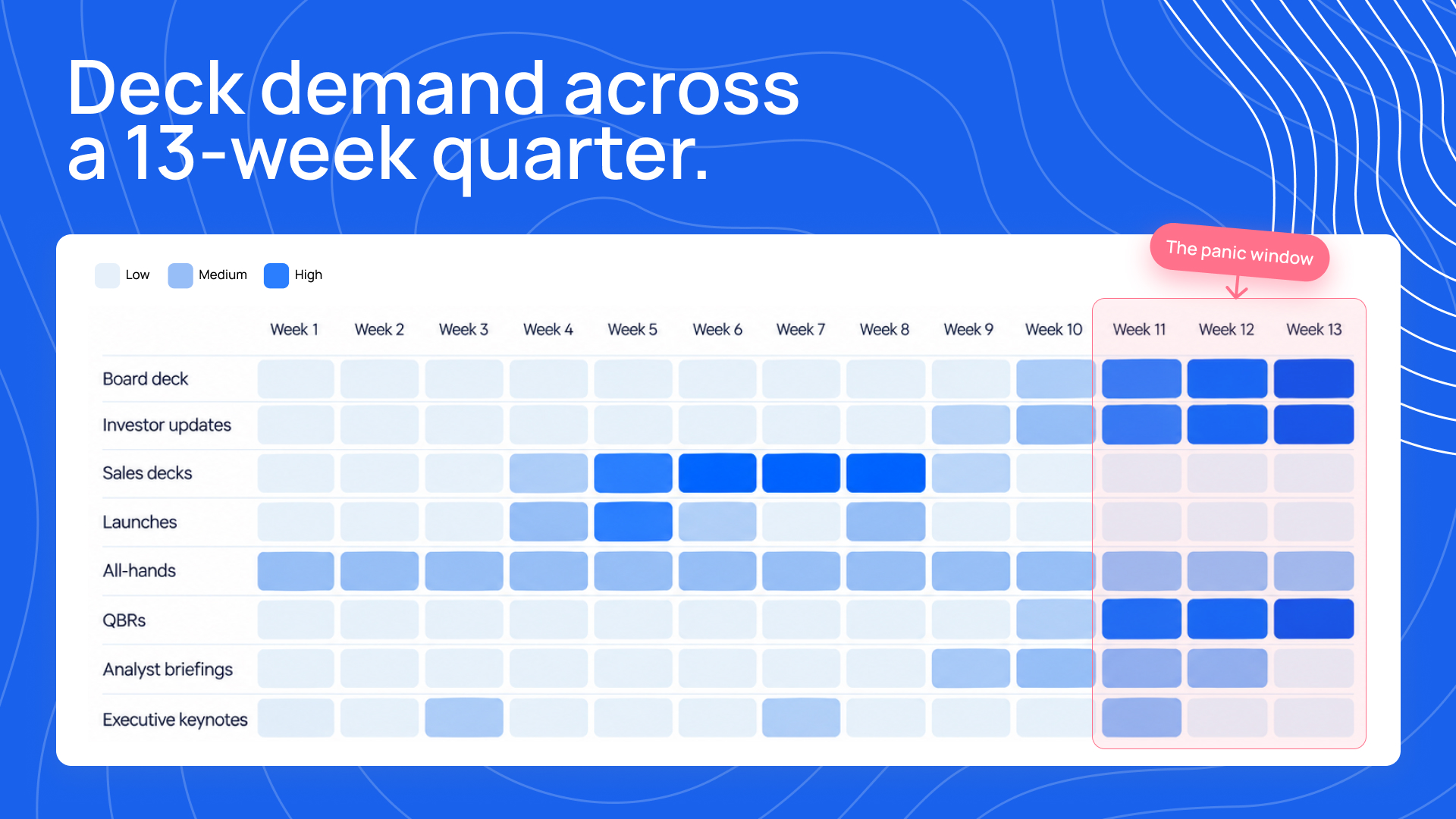
The work is spiky. Deck demand concentrates in week 11-13 of each quarter (board prep, QBRs, investor updates) and around major launches. Steady-state capacity does not match actual demand.
The quality bar varies by audience but the brand should not. An internal all-hands deck can be rougher than an investor deck. But both should look like they came from the same company. Brand consistency across every deck is non-negotiable at this stage because inconsistency reads as organizational immaturity.
The strategic owner is not the design owner. You, as Head of Marketing, decide what the deck says. Someone else should decide how it looks. If those two jobs collapse into one role, that role is either you (and you are drowning) or an in-house designer (whose time is now split across every function in the company).
The four deck production models (and when each one fits)
Growth-stage marketing teams try one of four production models. Each has a specific failure mode you should know going in.
Model 1: Marketing Operations handles design in-flow
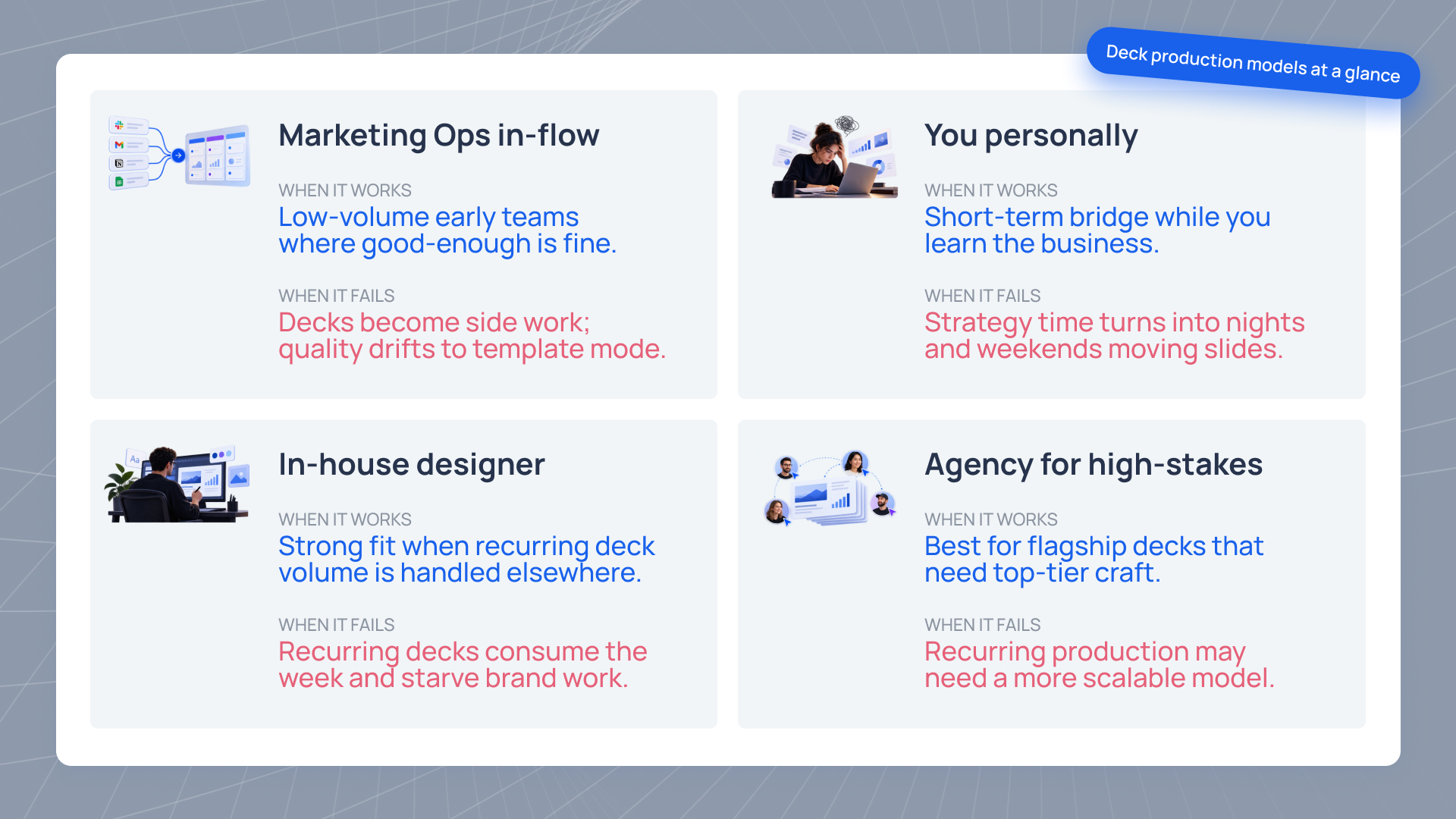
The Marketing Ops hire has 'design' in their job description because the hiring manager meant 'can use Canva.' This person inherits deck production on top of whatever else they are doing - email QA, Salesforce reporting, campaign launches, lifecycle flows.
The failure mode: Design output drifts to the lowest-common-denominator template because that is what fits inside the time available. The person doing deck work resents it because it was not what they signed up for. The brand looks increasingly rough across quarters as deck volume grows and this person has less time per deck.
When it works: Pre-Series-A teams with low deck volume where "good enough" is actually fine and the Marketing Ops person has genuine design skill they want to use.
Model 2: You, personally, handle design yourself
Many Heads of Marketing come from backgrounds (product marketing, growth, brand) where they picked up strong design taste along the way. The deck feels like it is faster to just do yourself than to brief and review.
The failure mode: Your evenings. Your weekends. The fact that the strategic decisions you should be making next quarter are not getting made because you are moving a chart three pixels to the right. Design-capable Heads of Marketing routinely underprice their own time doing this work and overvalue the strategic cost of the time they lose doing it.
When it works: The first few quarters of a role where you are still learning the business and need deep contact with every artifact that leaves marketing. A short-term bridge, not a sustainable model.
Model 3: In-house designer, hired for brand work
You convince finance to hire a brand designer. Great hire. They own the brand system, product marketing surfaces, event collateral, and - gradually, then suddenly - every deck the company ships.
The failure mode: Deck production consumes 60-70% of your in-house designer week by month six. Brand work gets starved. The thing you hired them to build (consistent brand system, product marketing visual language, campaign surfaces) stops happening because they are producing board decks and QBRs instead. By quarter three they are either burning out or quietly looking for roles where they can do actual brand work.
When it works: When paired with a design subscription that absorbs recurring deck production. The in-house designer owns the brand across every surface; the subscription owns the recurring deck volume. This is the pattern most Series C+ marketing teams end up at within a year of their first design hire.
Model 4: Freelancer or agency for high-stakes decks only
You maintain a shortlist of freelancers or a relationship with a specific agency. For the board deck, the investor pitch, the annual report - you engage per project.
The failure mode: Everything that is not high-stakes-enough-to-engage-the-agency falls back on Models 1 or 2. The brand looks great in the handful of decks that get the external treatment and inconsistent everywhere else. The gap between those two tiers of decks is visible to anyone paying attention, and it signals that production quality tracks deck importance rather than company standard.
When it works: For specific one-off projects where you need world-class craft (a brand launch, a flagship investor pitch, a major keynote). Not sustainable as the primary model for recurring deck work.
For a deeper look at the agency vs freelancer vs subscription tradeoffs, see our presentation agency vs freelancer vs subscription comparison.
The hybrid model that most growth-stage marketing teams end up at
The honest answer for most Series B through Series D marketing teams is a hybrid: one in-house brand designer plus a design subscription for recurring deck production.
The split works like this:
The in-house designer owns the brand system, product marketing surfaces, event collateral, campaign visual direction, and the handful of highest-stakes decks per year that benefit from strategic design conversations in the room (annual report, major launch deck, flagship investor pitch).
The subscription absorbs everything else: board decks quarterly, monthly investor updates, sales decks tailored per enterprise prospect, customer QBRs if those come through marketing, all-hands slides, analyst briefings, and the recurring stream of what-just-came-up-this-week decks that would otherwise consume your in-house designer week.
The economics usually work out favorably compared to hiring a second designer. A good senior designer at growth stage lands at roughly $120-180K fully loaded in the US. A design subscription at the volume most Series C marketing teams actually ship runs significantly less than that, and it comes without ramp time, PTO coverage gaps, or the risk of a single-person turnover event taking brand memory with them.
The quality case is often stronger than the cost case. A subscription focused specifically on decks develops deeper deck-specific craft than a brand-focused generalist designer typically has time to maintain. The in-house designer, in turn, gets to work on the surfaces where their brand expertise actually compounds instead of producing board deck 47.
Our full breakdown of the subscription vs in-house tradeoffs, including the honest cost math, is in the design subscription vs in-house designer comparison.
What to look for when you evaluate a design partner for decks
If you are at the point of looking at design subscriptions or agencies for the deck workload, five things determine whether the partner will actually hold up over 12 months of recurring work.
1. Deck specialization vs generalist production
A design partner that treats decks as 'one of many things we do' will produce decks that look like one of many things they do. A specialist deck team will catch conventions and craft details a generalist misses - how a board deck should pace, what makes an investor update land in 30 seconds, how a sales deck should build tension across 15 slides.
The question to ask: how many decks has the lead designer on my account shipped in the last 12 months? If the answer is single digits, you are not getting a specialist.
2. A persistent design system, held by the designer
"Will you build us a template?" is the wrong question. Templates decay. The right question is whether the partner maintains a living design system for your brand that evolves across the subscription, held by the specific designer working on your account.
A system that lives in the designer head (color decisions, type hierarchy choices, chart conventions, layout logic, voice of visual elements) is more durable than any template file. It is also the thing that keeps deck 47 looking like deck 1 ten months in.
3. A named senior designer on your account
If the partner rotates designers across your work or assigns whoever is free that week, you will see brand drift within two quarters. This is the quiet failure mode of most generalist design subscriptions. A named senior designer who holds your account every month and knows your business is a different product.
The question to ask: who specifically will work on our account? What is their background? Can we see examples of their work? If the answer is vague, that is the answer.
4. 24-hour turnaround as the default
Marketing timing is not something you can predict more than two weeks out. The CEO wants slides for a surprise fireside chat tomorrow. The CRO wants a tailored deck for a prospect call Thursday. Analyst briefing moved up a week. If every deck requires a four-to-ten-day cycle, the partner is already behind on your actual workflow.
A 24-hour default (first draft, with iteration from there) is the only cadence that actually matches how growth-stage marketing orgs operate. Partners that cannot sustain that without charging rush fees are not priced for the work you'll give them.
5. Native delivery across the tools your company actually uses
You might run on PowerPoint. Your CEO might work in Keynote. Finance might send IR decks as Google Slides. A new product manager might show up asking for Figma Slides. A customer success team might be building QBRs in Canva because that is what they know. If your design partner only works in one of these, half your organization still needs to copy-paste out of their native tool.
A partner that delivers natively across PowerPoint, Keynote, Google Slides, Figma Slides, and Canva - not export, but native - saves you the operational friction of maintaining five parallel template files for every brand update.
For a deeper look at how to think about each option in the space, including the specific tradeoffs of major providers, our compare directory walks through 15 options a growth-stage marketing team typically weighs.
Signals that you have outgrown your current deck production model
Five signals, in no particular order, that your current approach has stopped scaling with your workload.
- You personally touch more than 20% of the decks that leave marketing. Your calendar does not have room for strategic work because deck production is still eating it.
- Your in-house designer is spending more than half their week on decks. The brand work you hired them for is drifting. They are telling you (or not telling you, but should) that they want to do actual brand work.
- Decks that go to different audiences no longer look like they came from the same company. Investor deck looks great; sales decks look amateur; QBR decks look like three different companies.
- Your team is routinely in panic mode in week 11-13 of each quarter because board prep, QBRs, and investor update all land at once. The pattern repeats every quarter without resolution.
- You have had to decline executive deck requests because capacity ran out. "No, we cannot build you a keynote deck for TechCrunch Disrupt next month" is a signal that production capacity has become a limiting factor on business opportunity.
If three or more of these are true in your org right now, the current production model has run its course. The honest conversation to have with your team is whether the right next move is hiring (another in-house designer, with the ramp cost and management overhead that comes with it) or subscribing (a dedicated deck team with lower lift and faster time to productivity).
The 90-day transition plan
If you decide to move to a hybrid model (in-house designer + subscription for decks), the transition is manageable in a quarter.
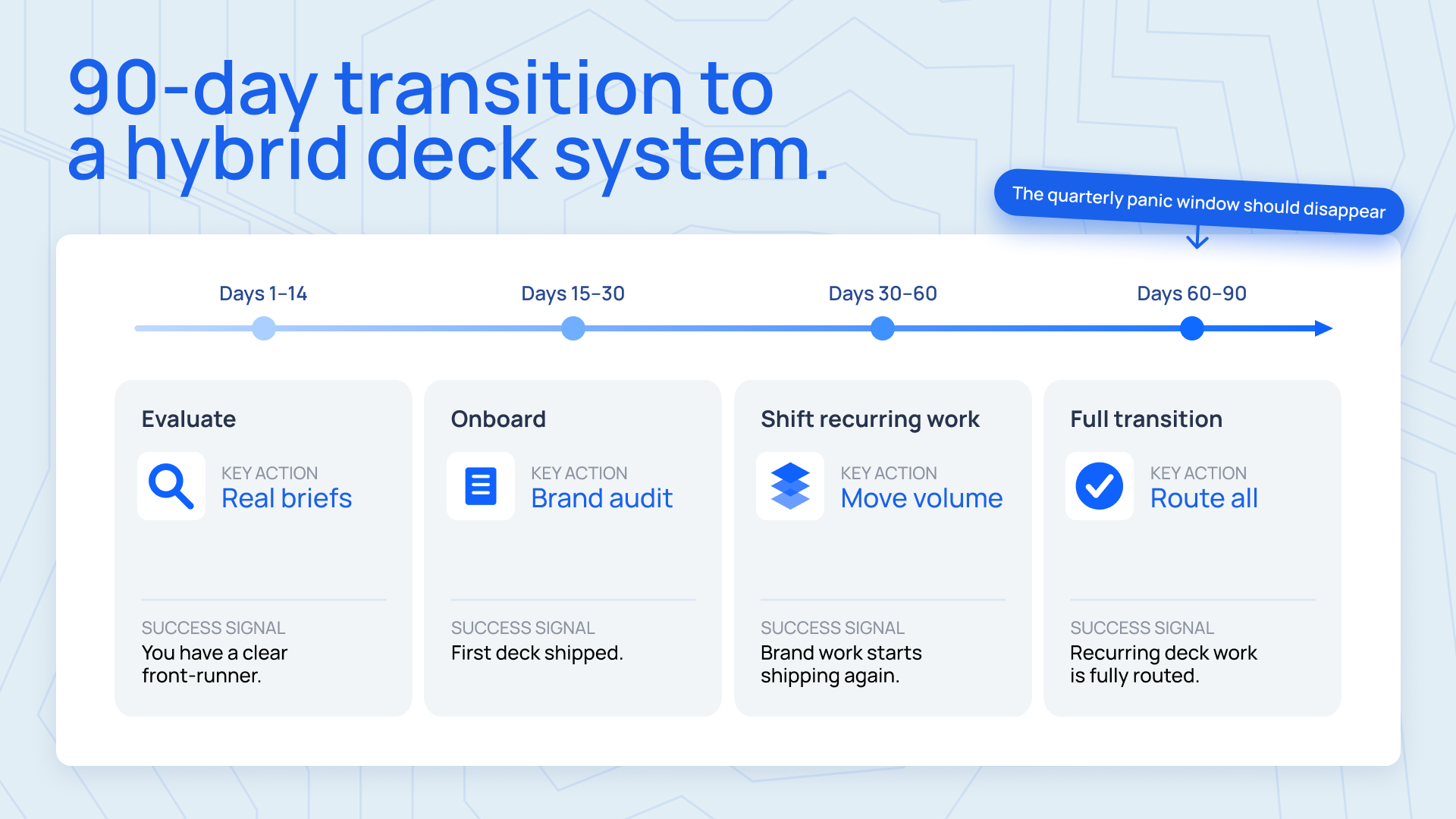
Days 1-14: Evaluate 2-3 design subscriptions against your actual deck workflow. Not demos - send them real briefs for upcoming decks and see what they produce. Pay for a month of each if needed. Quality judgments from samples beat judgments from pitches.
Days 15-30: Pick a partner. Onboarding should take one to two weeks - brand audit, design system build, first deck production. If a partner says onboarding takes a month, that is their internal process constraint, not a real design constraint.
Days 30-60: Shift recurring deck production (board, investor update, sales decks, QBRs) to the subscription. Keep high-stakes one-offs with your in-house designer or freelancer during the transition. Watch what happens to your in-house designer calendar - the signal of success is that brand work starts getting shipped again.
Days 60-90: Full transition. All recurring deck work routes through the subscription. In-house designer owns brand, product marketing surfaces, and the top-tier flagship decks per year. Audit the week-11-13 panic pattern - if it is gone, the model is working.
By day 90 you should know whether the hybrid model is the right shape for your org. The signal is not just that decks are getting produced faster. It is that your week has strategic room in it again and the quality bar across every deck the company ships has leveled up.
Build your marketing deck system with Slidecore
Slidecore is the monthly design subscription growth-stage marketing teams use to absorb recurring deck production. Named senior designer per account with 10+ years of deck experience. Persistent design system per client. 24-hour turnaround per deck. Native delivery in PowerPoint, Keynote, Google Slides, Figma Slides, and Canva. From $2,500 per month. See the pricing at slidecore.co/#pricing.
Frequently asked questions
As a directional rule: more than three to four substantive decks a month, or recurring work (board quarterly + investor updates monthly + sales decks per prospect) is where subscription math beats per-project freelance. Below that, freelance per project is often cheaper and simpler. Above that, the sourcing, briefing, and consistency overhead of multiple freelancers starts to exceed the cost of a subscription.
Brand system ownership, product marketing surfaces, campaign visual direction, event collateral, and the top-tier flagship decks per year (annual report, major launch, flagship investor pitch). Not the recurring volume of board decks and QBRs - that work drowns a brand designer within six months and is better absorbed by a subscription or specialist.
Frame it as deck production capacity, not design headcount. A design subscription at $2,500-$6,000/mo is less than the fully-loaded cost of a mid-level designer and comes without ramp time, PTO coverage, or hiring risk. It also comes out of marketing opex rather than headcount budget, which is often where the actual friction lives with finance. See the honest math in our 'design subscription vs in-house designer' comparison.
Depends on your operating model. Some marketing orgs route all deck requests through marketing to keep the brand bar consistent. Others open the subscription to sales, product, and CS for their own deck needs with a shared design system. The second model distributes production work but requires that the design system is strong enough to hold brand consistency without marketing policing every request. Most growth-stage orgs end up at the second model within 6-12 months.
The honest answer: ask the partner about their largest clients and the volume those clients ship. If their largest account ships 25 slides a month and you'll be shipping 100, you are going to be their biggest customer and might outgrow them. If their accounts range up to several hundred slides per month, you have headroom. Also ask about their account continuity model - who holds the brand if a single designer leaves.
Send them a real deck brief with actual stakes - something you would otherwise give to your best designer. Not a demo brief, not a fictional one. See what they produce in 24 hours. The quality of that one output tells you more than any sales conversation. The 'try before you commit' value of a subscription with no annual lock-in is that this test is cheap.
Depends on the subscription. Generalist subscriptions (Designjoy, ManyPixels, Penji, Design Pickle) cover a broad surface including web, branding, illustration, and sometimes video. Deck-specialist subscriptions (Slidecore, Slidebase, 24Slides) focus narrowly on decks and the surrounding presentation craft. The generalist option gives you more scope coverage; the specialist option gives you more depth on decks specifically. Which fits depends on whether your in-house designer is already handling brand and product marketing surfaces, in which case specialist deck depth is the gap you are filling.

Founder, Slidecore
Giorgi founded Slidecore to give teams a senior design partner for decks. His teams have designed 500+ decks for 100+ companies across SaaS, AI, fintech, and healthcare.
Meet the founder →Want decks like this for your team?
A design studio on subscription for every deck, report and keynote you ship.