Presentation Agency vs Freelancer vs Subscription: Compare the Failure Modes
Compare the failure modes, not the price sheets: honest cost math and a decision framework for choosing an agency, freelancer, subscription, or hybrid.
Every guide comparing a presentation agency to a freelancer to a subscription is written by one of the three. Ours is too. We run a subscription. That vested interest is the standard disclosure at the top of these guides. What most guides actually miss, though, is the more useful lens. For specific vendors within each model, see our top 10 deck design agencies and subscriptions roundup.
Comparing on cost is what every ranking page does. Sticker prices are visible. Hourly rates are visible. Monthly retainers are visible. Every comparison table lists them. But cost is not usually the decision that trips growth-stage teams up. The decision that trips them up is what happens when the model does not fit the work.
Each of the three outsourced design models has a specific failure mode. Agencies fail slow and expensive. Freelancers fail variable and unavailable. Subscriptions fail on strategic depth. If your work shape does not fit the model, you experience the failure mode. And the failure mode almost always costs more than any theoretical savings from picking the "cheapest" option upfront.
This guide compares the failure modes, not the price sheets. It walks through what each model actually is, the honest cost math across all three, each model's specific failure mode and what it costs when it triggers, when each model genuinely wins, how the three fit into the hybrid answer most growth-stage teams end up with, the common mistakes when picking a partner, and a decision framework to match your workload shape to the right model.
Written for the CMO, Design Lead, Chief of Staff, or founder evaluating outsourced design partners for growth-stage design work - especially presentation-heavy work like board decks, investor updates, sales decks, and executive keynotes.
This post extends the earlier guide on whether to hire a designer in-house at all. If you have not read that one, start there and come back.
The Three Models: What Each Actually Is
Naming them clearly matters, because the labels get used loosely and each model has genuine variance within it.
- 1Presentation agencyA firm that takes on presentation design projects with a defined scope, timeline, and deliverable. Typically project-based ($8,000 to $60,000 per engagement) or retainer-based ($8,000 to $20,000 per month for multiple concurrent projects). Includes account management, creative direction, and sometimes strategy work. Timelines are measured in weeks. Best-known examples in the space include Superside, Duarte, and mid-market boutique firms.
- 2FreelancerA single independent designer engaged directly or through platforms (Upwork, Contra, Toptal, personal networks). Hourly ($75 to $200 per hour for growth-stage-quality presentation design) or fixed-project pricing. No account management, no team backup, no formal creative direction beyond what the individual designer provides. Best for well-defined one-off work.
- 3Design subscriptionA monthly recurring service that gives a company ongoing access to a design team, usually for a fixed monthly fee, with defined turnaround times and scope. For growth-stage-quality presentation design in 2026, subscriptions run $2,500 to $15,000 per month. No hiring, no benefits, no ramp. Pause or cancel at month-end. Built for recurring or spiky output work like decks, marketing collateral, sales materials, and launch campaigns.
Two adjacent models sit outside this comparison but come up in the same conversations. In-house designers are covered in the earlier subscription-vs-in-house guide. Full-service brand or product design agencies (as distinct from presentation agencies) are a different animal used for brand definition and product surfaces, not the recurring presentation work this guide focuses on.
The Real Cost Math (All Three, Honest Numbers)
Sticker prices are misleading in isolation. What matters is total cost of ownership: the price plus the management overhead plus the failure-mode cost when it triggers. Below are the honest ranges for a growth-stage US company in 2026 shipping recurring presentation work (roughly 6 to 12 decks per month).
Presentation agency (project-based or retainer)
Project pricing: $8,000 to $60,000 per engagement for a substantial presentation project (board deck redesign, investor day deck, launch presentation). Retainer pricing: $8,000 to $20,000 per month for ongoing access. Add account management time on your side (10 to 20 hours per month across briefings, reviews, and revision cycles). Add change order costs when scope expands ($2,000 to $5,000 typical per change). Turnaround: 2 to 6 weeks for most substantive projects.
Annual cost if used for consistent output at 6 to 12 decks per month: $120,000 to $250,000, higher if the agency is a well-known brand-name firm.
Freelancer
Hourly rates: $75 to $200 per hour for growth-stage-quality presentation design. Per-project rates: $1,500 to $8,000 for a substantial deck depending on scope. Multiple projects per month usually mean multiple freelancers because most senior freelancers cannot commit to consistent volume. Add search and vetting time on your side (3 to 8 hours per new freelancer). Add per-project re-briefing cost (5 to 10 hours per new project).
Annual cost if used for consistent output at 6 to 12 decks per month: $60,000 to $180,000, but with high variance and no guarantee of consistent quality or availability across quarters.
Presentation design subscription
Monthly pricing: $2,500 to $15,000 per month for growth-stage-quality work. Slidecore's pricing sits inside this range. Includes senior designers, template stewardship, direct communication, defined turnaround (usually 48 to 72 hours per deck across the category; Slidecore delivers within 24 hours per deck). No hiring, no benefits, no ramp beyond the initial one-to-two-week onboarding. Pause or cancel monthly.
Annual cost if used for consistent output at 6 to 12 decks per month: $30,000 to $180,000. Lower ceiling because throughput scales without additional overhead once the template is locked.
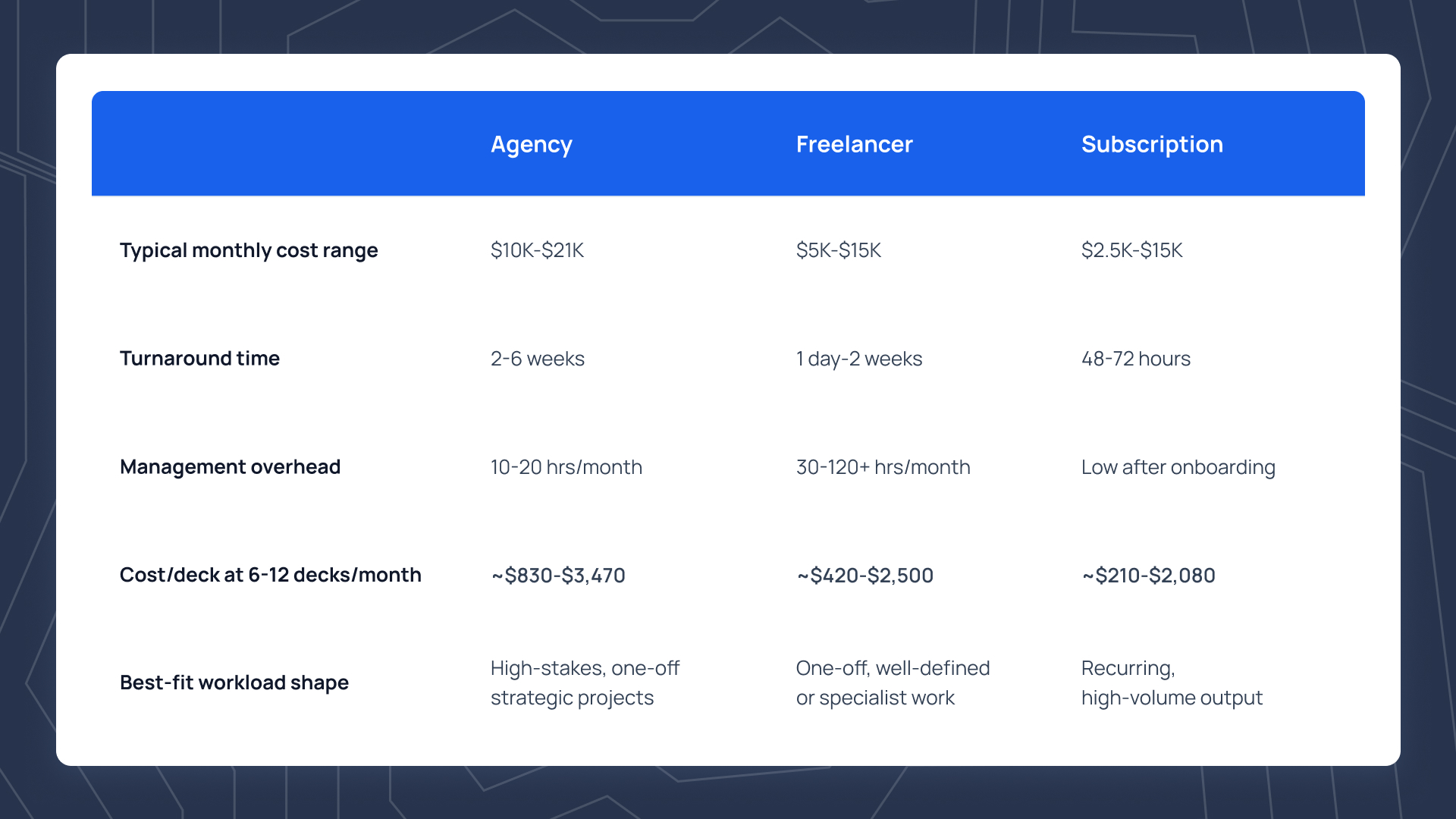
| Agency | Freelancer | Subscription | |
|---|---|---|---|
| Typical monthly cost range | $10K-$21K | $5K-$15K | $2.5K-$15K |
| Turnaround time | 2-6 weeks | 1 day-2 weeks | 48-72 hours typical; Slidecore: 24 hours |
| Management overhead | 10-20 hrs/month | 30-120+ hrs/month | Low after onboarding |
| Cost/deck at 6-12 decks/month | ~$830-$3,470 | ~$420-$2,500 | ~$210-$2,080 |
| Best-fit workload shape | High-stakes, one-off strategic projects | One-off, well-defined or specialist work | Recurring, high-volume output |
Each Model's Specific Failure Mode (The Comparison That Actually Matters)
This is the argument the whole SERP fumbles. Every model works when the workload fits. Every model fails specifically when it does not. Understanding how each one fails is more useful than comparing their price sheets.
The agency failure mode: slow and expensive
Agencies fail on cadence. When you hire an agency to produce a board deck, they produce an excellent board deck - in six weeks. The problem is your board meeting is in three weeks, and even if it were in six weeks, the next one is in three months and you would need to run the whole engagement again. Agencies are optimized for high-touch discrete projects with long timelines, not for the quarterly recurring output that growth-stage teams actually need.
When the agency model fails, the failure looks like: $40,000 sunk into a launch deck that arrives late, followed by an internal scramble to update it in-house, followed by a decision to not use the agency next quarter. The money is gone. The template drift starts immediately.
Agencies also carry a hidden coordination cost. Account managers, creative directors, project managers, and designers all sit between you and the work. Every round of feedback goes through the account manager. Every clarification is a slack thread across three people. What feels like "professional service" from the outside is often the source of the two-week turnaround times that make agencies feel slow.
The freelancer failure mode: variable and unavailable
Freelancers fail on availability and consistency. The best freelance presentation designers are also the busiest ones, and their calendars fill up months in advance. When you need a board deck refresh in six days and your freelancer is on another client's launch, the answer is no. When your usual freelancer takes vacation the week you need the sales deck refreshed, the answer is no. When a freelancer goes on parental leave for three months, you have to find and re-brief a new one from scratch.
Consistency across projects is the second failure mode. Each freelance engagement is essentially a fresh start. The designer who did last quarter's board deck may not do next quarter's. The brand context has to be rebuilt every time. Chart styles drift. Typography drifts. Color palettes drift. By quarter four, your board decks look meaningfully different from each other, and directors notice.
When the freelancer model fails, the failure looks like: a critical deck is delayed by two weeks because your designer is unavailable, followed by a scramble to find and brief a replacement, followed by a deck that does not quite match the brand.
The subscription failure mode: less strategic depth
Subscriptions fail on high-touch creative direction and truly novel work. When you need a genuinely new brand system, a category-defining launch campaign, or a strategic rebrand, a subscription is not the right partner. Subscriptions are optimized for high-throughput output work with a locked template, not for the deep strategic work that shapes the template in the first place.
When the subscription model fails, the failure looks like: a big launch deck that lacks the strategic creative depth an agency would have brought, or a rebrand attempted through incremental subscription work that never quite lands. Both are real, and they are why the honest answer for most growth-stage teams involves more than one model.
When Each Model Genuinely Wins
Being honest about when each model is the right call is what separates a comparison guide from an ad. Below is the honest version.
When an agency wins
A defining brand project. A major rebrand. A launch campaign that needs strategic creative direction across multiple deliverables. A one-time investor day deck that needs to be exceptional. Any project where the strategic creative work matters more than the throughput, and the timeline supports the long agency cycle.
Also: highly regulated industries (healthcare, finance, defense) where agencies have specific compliance and review workflows that generalist subscriptions do not. If your industry has regulated marketing material, an agency with vertical experience may be the safer choice.
When a freelancer wins
One-off well-defined projects. A specialist need (a world-class type designer for a wordmark, a specific illustration style, a motion designer for a single video). Very early-stage companies with occasional design needs under five hours per month. Any situation where you can hand off a clean brief, get back complete work, and not need to think about it again.
Freelance is also the right model when you need world-class specialist talent that would not fill a full-time role or a subscription retainer. Top-tier illustrators, motion designers, and type designers usually work freelance.
When a subscription wins
Recurring presentation output at meaningful volume. Board decks every quarter. Investor updates every month. Sales decks refreshed quarterly. Marketing collateral shipping continuously. Any workload where the value comes from consistent throughput, brand consistency across many deliverables, and a locked template that holds across time.
Subscriptions also win when speed matters. A subscription can turn around a board deck refresh in 48 to 72 hours because the template is already locked and the designers already know your brand. Agencies cannot match this speed without dropping quality. Freelancers cannot match this speed unless you happen to catch them at the right moment. Slidecore delivers the first draft within 24 hours per deck.
The Hybrid Answer for Growth-Stage Teams
Just as the earlier subscription-vs-in-house guide concluded that most growth-stage teams run both models, most teams also end up using more than one of the outsourced options - not one exclusively.
The typical growth-stage design org, once thought through:
- 1One design subscriptionHandles all the recurring output: board decks, investor updates, sales decks, marketing collateral, launch assets. Ships continuously with locked-template consistency. This is the default 80-percent solution for most growth-stage output work.
- 2One agency, engaged annually for the big strategic projectA rebrand every three years, a major investor day deck every 18 months, a category-defining launch every 24 months. The agency is not a monthly relationship; it is a specific engagement when strategic depth genuinely matters.
- 3One or two trusted freelancersFor specialist work: a specific illustrator for launch materials, a motion designer for the annual highlight reel, a specific typographer for the wordmark. Not the primary partner, but the specialist bench.
This portfolio is more common than the single-vendor answer at Series B and above. It works because each model is used for exactly the work it is good at, and none is asked to perform outside its zone of competence.
The Common Mistakes When Choosing an Outsourced Design Partner
Six patterns to avoid, from the many growth-stage teams that have gotten this decision wrong.
- 1Comparing on monthly price without comparing on cost per deckA $3,000 subscription that ships 8 decks is $375 per deck. A $500 freelancer engagement for one deck is $500 per deck. The subscription is cheaper per unit at any real volume, even though the monthly number looks higher. Fix: normalize to cost per deliverable before comparing.
- 2Using an agency for recurring workEvery quarter the agency runs a fresh engagement cycle. Every cycle burns internal time on briefings, revisions, and account-management overhead. By quarter four, you have paid enterprise agency rates for output that a subscription would have delivered faster and cheaper. Fix: use agencies for discrete projects, not recurring output.
- 3Using freelancers for recurring work at volumeEvery project is a re-brief. Every quarter is a different designer. Brand consistency drifts within two quarters. Fix: freelance for one-off work, subscription for recurring.
- 4Choosing a subscription too small for the workloadA $500 subscription is not going to produce enterprise-quality board decks. If you sign up expecting enterprise output at consumer pricing, the subscription will underdeliver and you will conclude "subscriptions do not work." Fix: match the tier to the actual workload; expect growth-stage-quality subscriptions to sit in the $3,000 to $10,000 per month range for presentation-heavy work.
- 5Choosing on price sheet instead of failure modeThe cheapest option looks best on the spreadsheet. But if the model does not fit the work, you experience the failure mode - which almost always costs more than any theoretical savings. Fix: identify which failure mode your team can tolerate, and pick accordingly.
- 6Assuming one model has to do everythingMost growth-stage teams run some combination of subscription + occasional agency engagement + specialist freelancers. Fix: think of it as a portfolio, not a single-vendor decision.
A Decision Framework: Match the Model to Your Workload Shape
Three questions to work through, in order.
Question 1: Is the work one-off or recurring?
If one-off (a specific defined project, ending when it ends), agency or freelancer depending on scope. If recurring (monthly, quarterly, ongoing), subscription. This is the single biggest fork in the decision and the one most teams get wrong when they use agencies for recurring output.
Question 2: How much strategic depth does the work need?
If the work needs deep strategic creative direction (a rebrand, a category launch, a major campaign), agency. If the work is executing well against an existing brand system with a locked template, subscription or freelancer. Freelancers can execute well but rarely provide strategic creative direction at agency depth.
Question 3: What is the throughput?
Under 5 hours per month of design work, freelancer. 5 to 40 hours per week of consistent recurring output, subscription is almost always the right call. Over 40 hours of consistent work, hire in-house (covered in the earlier guide on subscription vs in-house). Add an agency for the annual strategic project on top of whichever is your primary partner.
If your answers are "recurring + execution-focused + moderate to high throughput," the right partner is a subscription. That is Slidecore's ICP, and it is the answer most growth-stage teams shipping presentations at scale eventually arrive at.
If subscription is your answer, here is how Slidecore works.
Monthly design subscription. Senior designers on your account. Locked template, 24-hour turnaround per deck, direct communication, pause anytime. Built for growth-stage and enterprise teams shipping board decks, investor updates, sales decks, and marketing collateral on a recurring cadence.
See how Slidecore works, explore pricing, or book a call to discuss your recurring deck work.
Frequently Asked Questions
For discrete high-stakes strategic projects, yes. For recurring output work, no. Agencies deliver strategic creative depth that subscriptions and freelancers cannot match, but they take 2 to 6 weeks per project and cost 3 to 5 times as much per deliverable at any real volume. Use agencies for annual strategic engagements (a rebrand, a category launch, a major investor day) and use a subscription for the recurring board decks, sales decks, and investor updates in between.
Subscription is fastest for typical output work (48 to 72 hours per deck once onboarded), because the template is already locked and the designers know the brand. Freelancers vary widely (24 hours to 2 weeks depending on availability). Agencies are slowest (2 to 6 weeks for substantive projects) because of the account management, review, and revision cycles baked into the engagement model. Slidecore delivers the first draft within 24 hours per deck.
At any real volume, yes. A $3,000 subscription that ships 8 decks a month costs $375 per deck. Freelance engagements at growth-stage-quality typically cost $1,500 to $8,000 per deck. The monthly sticker price of a subscription looks higher, but the per-deliverable cost is meaningfully lower once you cross about 3 to 4 decks per month.
Yes, and most growth-stage teams eventually do. The typical portfolio: one subscription for recurring output, one agency engaged annually for the big strategic project, one or two trusted freelancers for specialist work. Each model does the work it is genuinely good at, and none is asked to perform outside its zone.
You either upgrade to a higher tier (most subscriptions have multiple pricing tiers matching different throughput levels) or you add an in-house design lead alongside the subscription. This second move is the hybrid model discussed in the earlier subscription-vs-in-house guide, and it is where most Series C and enterprise companies end up.
Three tests. First: ask for portfolio work matching your specific deck type (board decks, sales decks, investor updates, not just generic branding work). Second: ask about turnaround times specifically for a refresh, not for a new build. Third: ask what happens if their key designer becomes unavailable. Vendors with real answers to all three have thought about their model. Vendors with vague answers usually have less consistent output than they market.
Yes. Pre-Series A: freelancer for occasional work, subscription only if you have real recurring volume (rare at this stage). Series A: subscription is usually the right primary partner, plus occasional freelancer. Series B: subscription plus in-house design lead in most cases. Series C: subscription plus in-house design team plus occasional agency for strategic projects. The mix gets richer as the company grows, but the subscription tends to be the constant across stages.

Founder, Slidecore
Giorgi founded Slidecore to give teams a senior design partner for decks. His teams have designed 500+ decks for 100+ companies across SaaS, AI, fintech, and healthcare.
Meet the founder →Want decks like this for your team?
A design studio on subscription for every deck, report and keynote you ship.