How to Build a Sales Deck That Actually Closes
Most sales decks are built for the AE giving the demo. The best ones are built for the champion forwarding it at 11pm. Structure, design decisions, and formats by deal size.
Most guides on how to build a sales deck treat it as a document you show up with, present, and use once. In reality, the deck gets used dozens of times after the meeting - forwarded to the VP Finance you never met, to procurement, to a technical evaluator, to the CFO - as your champion tries to sell the deal internally. That second life is where deals actually close, and most decks fail it.
The default sales deck is built for the AE giving the demo. Full-slide typography, minimal on-slide text, "the story is in the talk track." That works in the meeting. It falls apart the moment the deck lands in an inbox at 11pm with no context and no narrator.
This guide takes the opposite view. It walks through what a sales deck is, how it differs from a pitch deck and a board deck, why the deck gets used twice, the ten-section structure that scales from SMB to enterprise, what great opening slides do differently, which slides champions actually forward and which ones they skip, how the deck should change by deal size, the common mistakes that kill decks, the design decisions that make a deck read cleanly without you in the room, and how to systematize the whole thing across a sales org.
Written for the VP Sales, sales enablement lead, CMO, or founder who owns the sales deck as a real revenue asset.
What Is a Sales Deck?
A sales deck is the structured presentation a company uses to walk prospects through the problem it solves, the way it solves it, the proof that it works, and the reason to buy now. It is the core artifact of the mid-market and enterprise sales motion, and at most companies it is the single highest-leverage piece of collateral the sales team owns.
The sales deck is not one deck. It is a system that shows up in three forms: the discovery version an AE uses on a first call, the full presentation used in a scheduled demo, and the leave-behind (usually the same file, sometimes a shorter version) that the champion forwards to the rest of the buying committee. Great sales orgs build a single template that flexes into all three. Weak sales orgs let every AE build their own, and the brand and message drift within a quarter.
The best test of a sales deck is not "does the AE like presenting it." It is "does the deal keep moving in weeks two through six, when you are not in the room."
Sales Deck vs Pitch Deck vs Board Deck: Three Very Different Documents
Three artifacts that share the word "deck" and almost nothing else. Confusing them is one of the most common causes of a stalled deal.
A pitch deck sells vision to investors who do not know your company yet. Ten to fifteen slides. Aspirational. Used once per fundraising cycle. Its job is to earn a second meeting with a partner.
A board deck runs the recurring board meeting for directors with formal governance rights. Twenty to fifty slides depending on stage. Measured and specific. Quarterly cadence. Its job is to make the meeting a strategy discussion instead of a status update. If you are shipping one every quarter, see our guide on how to build a board deck.
A sales deck closes deals with prospects who are actively evaluating a purchase. Ten to twenty-five slides depending on deal size. Specific, credible, and structured around the buyer's decision process rather than the seller's product story. Used in every mid-market and enterprise sales cycle, dozens of times a week across the sales org. Its job is to move a deal from "interesting" to "signed."
Confusing them is expensive. Sales decks that read like pitch decks make the prospect wonder if the company is still trying to raise money. Pitch decks that read like sales decks bore investors with product detail. Board decks that read like sales decks make the CEO look like they are still selling the board on the strategy. Each artifact serves a different audience with different questions in mind. The design of each has to match.
The Deck Gets Used Twice: Design for the Second Use
This is the argument the whole SERP fumbles. Every ranking page describes the sales deck as the thing an AE presents in a meeting. In reality, the deck has two lives, and the second one is where deals close.
The first life is the meeting itself. An AE walks a prospect through the slides live, either in person, over Zoom, or during a discovery call. Design constraints for this use case are the ones every guide covers: legible from ten feet away, one story per slide, buyer language not seller language, presenter has the talk track memorized. Standard advice.
The second life starts the moment the meeting ends. The prospect - who is now hopefully your champion inside the account - forwards the deck. To the VP Finance who needs to sign off on the budget. To the technical evaluator who has never spoken to you. To the CFO who will decide if this is a priority. To the CIO who needs to approve the security review. To procurement. Every one of those forwards is a person reading the deck at 11pm, on a phone, with no narrator, no context, and no reason to spend more than ninety seconds on it.
The deck has to make the same argument, cleanly, in both settings. That is the design problem. And it is why the sales decks that actually close deals look different from the ones optimized for the AE's presentation.
The champion is the person doing the internal selling. Your job is to arm them. The deck is the ammunition.
What Should a Sales Deck Include? The Ten-Section Structure
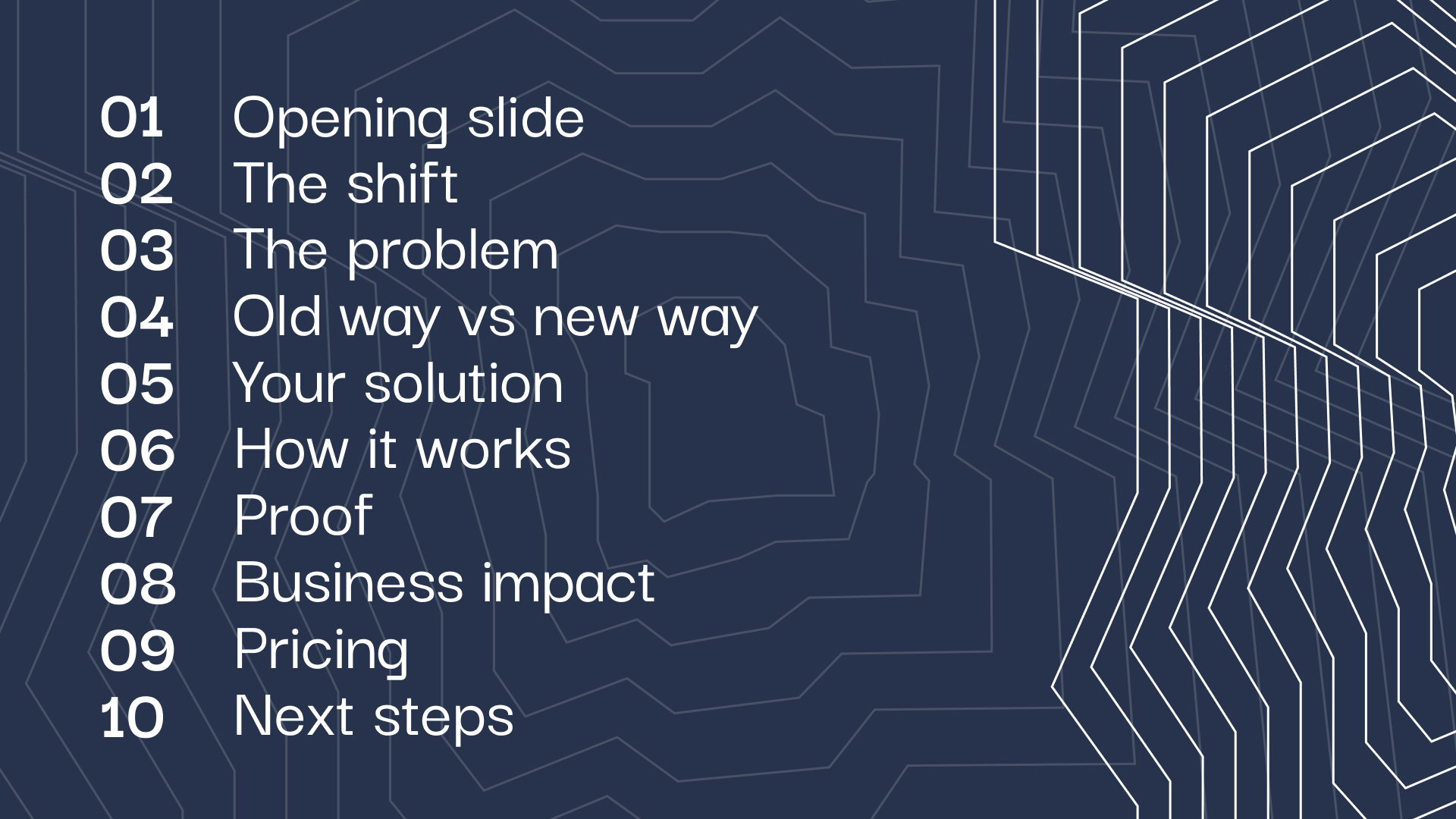
Every great sales deck follows the same underlying structure. The order matters. Each section builds on the previous one, and skipping any of them puts a hole in the story that surfaces later in the deal.
- 1Opening slideNot your company name and logo. A framing statement about the buyer's world. "Enterprise SaaS teams close 40 percent of qualified pipeline. The rest is lost to the same three objections." Something that signals within five seconds that the meeting is about them, not you.
- 2The shiftWhat is changing in the market that makes now a different moment than eighteen months ago. Regulation, buyer behavior, technology, workforce dynamics. This slide sets context and earns the right to talk about a problem.
- 3The problemNamed specifically enough to be credible. Not "sales teams struggle with productivity" - "AEs spend 8 hours a week rebuilding decks that never leave draft folders." Specific problems get specific budgets attached.
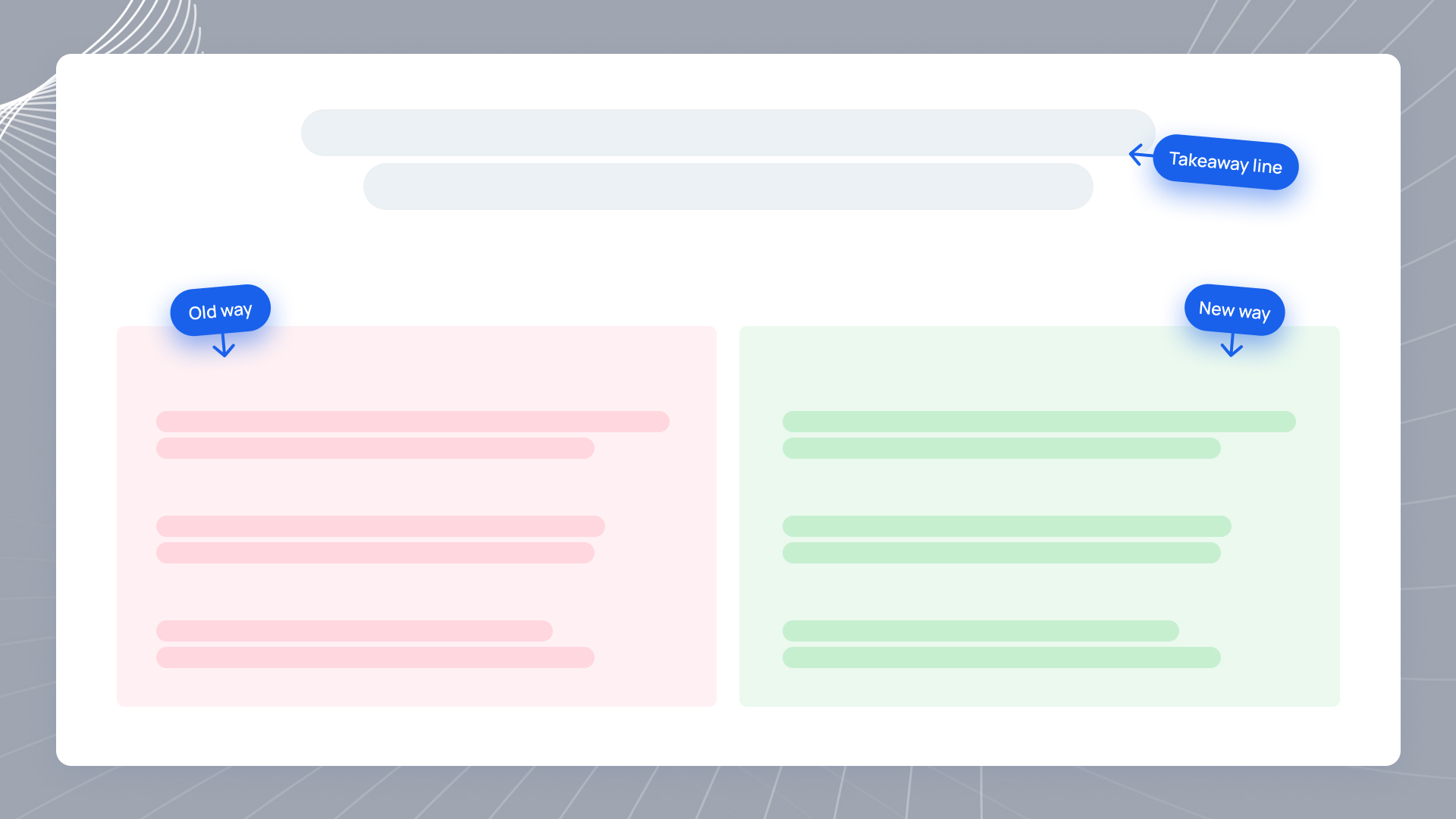
- 4Old way vs new wayThe single most effective visual pattern in B2B sales decks in 2026, according to analysis of top-performing enterprise decks. Two columns. What buyers used to accept as normal. What they now expect. Your solution lives on the right side.
- 5Your solutionFramed as the enabler of the new way, not as a feature list. One sentence on what you do. One sentence on the outcome. Not "our AI-powered platform" - "we cut deal cycle time by 30 percent by giving AEs on-brand decks in under 48 hours."
- 6How it worksConcrete, not vague. Three to five slides walking through the actual mechanic. A prospect who cannot explain how your product works after this section is not going to sell it internally.
- 7ProofCustomer logos, one flagship case study with real numbers, testimonial pull quotes. This section carries disproportionate weight because it is what the champion screenshots and forwards.
- 8Business impactThe ROI slide. A simple model showing what a customer at the prospect's scale can expect: cost savings, revenue lift, efficiency gain. Every number sourced, every assumption footnoted.
- 9PricingFor SMB and mid-market, real pricing on the slide. For enterprise, a placeholder ("investment range starts at X for teams of Y") with detail delivered separately. Never leave the deck without a clue about cost - it forces the champion to schedule another call.
- 10Next stepsNot "questions?" A specific proposed next step: "typical next step is a 30-minute technical review with your data team, then a business case walkthrough with the executive sponsor." Give the champion the words to bring the deal forward.
What Great Opening Slides Do Differently
The first slide is the most wasted slide in most decks. Company name, logo, tagline, and the word "Overview." A polite way of saying "we are about to talk about us for the next twenty minutes."
The opening slide is the highest-leverage slide in the deck. It is the one every stakeholder sees, and it is the one that sets whether the meeting is about the prospect or the seller. Change it, and the rest of the deck lands differently.
Three patterns work. The market claim: a one-sentence statement about the buyer's world that they will nod at ("Cybersecurity teams triage 40 percent more alerts than they did two years ago, with the same headcount"). The buyer question: a question the prospect has probably asked themselves ("How do you close mid-market deals when procurement takes 6 weeks?"). The outcome: a specific outcome your best customers see ("Your top AEs, closing 30 percent more mid-market pipeline in Q4"). Aspirational but concrete.
What does not work: your logo, your tagline, and the word "Introduction." Every second on a self-focused opening slide is a second the champion is losing interest.
The Slides Champions Forward, and the Slides They Skip
Slidecore has designed sales decks for teams selling into everyone from healthcare enterprises to Series B SaaS buyers. One pattern shows up in every one: the deck the champion forwards internally is not the full deck. It is a subset.
Understand which slides get carried forward and which get left behind, and you can design the full deck to bias the flow toward the ones that matter.
The slides champions forward. The old-way-vs-new-way slide, because it is a shareable framing of why the status quo has to change. The customer proof slide, because it is external validation the champion did not have to invent. The business impact slide, because it is the number they need to bring to the finance conversation. The next steps slide, because it tells everyone else what happens next. These four slides carry the deal.
The slides champions skip. The founding story slide, because internal buyers do not care where you came from. The team slide, because they will not be working with your team. The full product tour slide, because it is too much to absorb without an AE narrating. The competitive comparison slide, because it reads as biased even when it is accurate. These slides serve the meeting, not the deal.
The design implication is clear. The four slides that get forwarded should be built to stand alone. Each should read as a complete argument without a talk track. Full sentences on the slide, not bullet fragments. A single-sentence takeaway at the top. Enough context that a finance director opening it cold at 11pm can understand what it says. The other slides can be more presenter-driven, because they are unlikely to leave the meeting.
How Sales Decks Change by Deal Size
The ten-section structure holds across deal sizes. What changes is length, depth, and how much of the story lives in the appendix.
SMB deals under $25K
Eight to twelve slides. Twenty-minute presentation. One flagship customer proof point, not a full case study. Pricing on the slide, not a placeholder. The buyer is often a single decision-maker with budget authority, so the champion problem is smaller. Speed to close matters more than depth of proof.
Mid-market deals ($25K to $250K)
Twelve to eighteen slides. Thirty to forty-minute presentation. A named case study with numbers, not just logos. ROI slide is essential because the buyer will need to justify the spend internally. Pricing usually presented as a range with the exact number delivered in a follow-up. The champion problem starts here, and the deck has to arm them.
Enterprise deals over $250K
Eighteen to twenty-five slides in the main deck, plus a substantial appendix (security, compliance, integration architecture, phased rollout, sensitivity analysis on the ROI model). Fifty to seventy-five-minute presentation. Multiple stakeholders in the room, so the deck has to work for the CFO, the CISO, the technical evaluator, and the executive sponsor simultaneously. Modular design becomes structural: the AE brings different sections depending on who is on the call.
The Common Mistakes That Kill Sales Decks
Every sales deck mistake has the same root: the deck was designed for the seller, not the buyer. Six patterns show up again and again.
- 1Company-history openingFour slides on when you were founded, how many employees, office locations, and investors. The buyer stops listening before slide three. Fix: open with the buyer's world.
- 2Feature-first structureThe deck reads as a product tour: here is feature A, here is feature B, here is integration C. Buyers cannot map features to their own outcomes without a translator. Fix: outcomes first, features as evidence.
- 3No proof sectionA wall of customer logos does not count. Fix: one flagship case study with real numbers, plus three or four supporting logos. The champion needs external validation to sell internally.
- 4Too many slidesA forty-slide sales deck guarantees the meeting runs out of time before the close. Fix: get the core deck to ten to twenty slides, move everything else to the appendix.
- 5Vague next steps"Questions?" is not a next step. It puts the buyer in charge of the deal cycle. Fix: end every deck with a specific proposed next step the champion can point to.
- 6Every AE using a different deckWhen twenty AEs each edit the deck, the brand drifts within a quarter and the sales message becomes inconsistent. Fix: a locked template with modular swappable sections and version control owned by RevOps or sales enablement.
The Design Decisions That Actually Matter
Design decisions on a sales deck are not aesthetic. They are what determine whether the deck can stand alone in an inbox at 11pm. Five choices — drawn from the same executive presentation design discipline — do most of the work.
- 1One story per slideIf a slide has more than one takeaway, split it into two slides. A slide that has to be narrated to make sense is a slide that fails the champion. If your AE has to explain a slide, the finance director opening it Sunday morning has no chance.
- 2A takeaway line at the top of every slideNot the slide title - a full sentence that states the point of the slide. "Our enterprise customers close 30 percent more pipeline in Q4." "Compliance review typically takes 14 days, not 45." If a reader only reads the top line of every slide, they should still get the argument.
- 3Typography that reads without narrationBody text at 18pt minimum for a slide meant to be forwarded. Full sentences where full sentences are needed. Bullet fragments only when the slide is presenter-led and unlikely to leave the meeting. This is the biggest deviation from generic presentation design advice: sales decks that get forwarded need MORE on-slide text than presentation gurus recommend, not less.
- 4A locked visual template across the orgSame fonts, same chart styles, same slide layouts, same color coding, same footer. Every AE, every deck, every deal. When a champion is looking at proposals from three vendors on a Wednesday afternoon, the one that looks most consistently designed reads as the most operationally serious.
- 5Chart legibilitySame rules as board decks and investor updates. One data story per chart. Single-sentence takeaway above the chart. Axes labeled at the same size as body text. If a chart needs the AE to explain it, the champion cannot forward it.
How to Systematize Across the Sales Org
At most companies, sales deck version control is broken. Marketing produces a master deck. Enablement customizes it for a launch. Individual AEs then customize the enablement version for their deals. By the end of the quarter, twenty AEs are running twenty subtly different decks, the brand looks inconsistent across proposals, and the message drifts. Champions in enterprise deals show up in internal buying committees with mismatched slides across the vendors they are evaluating, and yours is the one that looks least organized.
Three moves fix most of it.
- Lock the master templateOwned by one function - usually marketing or sales enablement. AEs cannot edit the master. They can only assemble decks from approved modular slides.
- Build a modular slide librarySegment-specific case study slides, vertical-specific problem slides, deal-size-specific pricing slides, region-specific compliance slides. AEs mix and match from the library. Every slide in the library is on-brand because it lives in the locked template.
- Refresh the deck on a cadenceThe master deck should be reviewed and updated quarterly, not annually. The market shifts faster than that, and a deck that references a competitive landscape from twelve months ago undermines credibility with buyers who are current on the space.
The sales deck is one of the highest-ROI design assets a company owns. Every dollar of revenue passes through it. A deck that looks like it belongs to a serious company, ships on time when marketing needs to refresh it, and holds up across the whole sales org is worth ten times more than a beautiful deck the AE team cannot actually use.
This is where a design partner earns its keep. A locked template, updated quarterly, with a modular slide library that scales to twenty AEs and twelve segments, is a design system problem more than a design problem. And it is expensive to build in-house at growth stage, when marketing and sales enablement are already stretched.
Ship on-brand sales decks that scale across your entire sales org.
Slidecore designs sales decks, board decks, and investor materials for growth-stage and enterprise teams on a monthly subscription. Locked template, modular slide library, 24-hour turnaround per deck. See how we work with sales enablement, marketing, and RevOps leaders.
Frequently Asked Questions
It depends on deal size. Eight to twelve slides for SMB deals under $25K. Twelve to eighteen slides for mid-market deals between $25K and $250K. Eighteen to twenty-five slides in the main deck for enterprise deals over $250K, plus a substantial appendix for security, compliance, and technical detail. Above twenty-five core slides at any deal size and the deck is likely doing too much.
A pitch deck sells vision to investors who do not know your company yet. Ten to fifteen slides, aspirational, one-off per fundraising cycle. A sales deck closes deals with prospects actively evaluating a purchase. Ten to twenty-five slides depending on deal size, specific and credible, used dozens of times per week across the sales org. Confusing the two makes buyers think you are still trying to raise money.
Not your company name and logo. A framing statement about the buyer's world - a market claim, a buyer question, or a specific outcome your best customers see. The first slide should signal within five seconds that the meeting is about the prospect, not about the seller. Every second spent on a self-focused opening is a second the prospect is losing interest.
Twenty minutes for SMB deals, thirty to forty minutes for mid-market, fifty to seventy-five minutes for enterprise. These are targets for the live meeting, not for the entire deck length. The deck itself often runs longer than the presentation because sections are modular and the AE selects what to cover based on which stakeholders are in the room and what the prospect wants to focus on.
For SMB and mid-market deals, yes - real pricing on the slide, so the buyer has enough information to move the deal forward. For enterprise deals, a range or placeholder is usually right, with detail delivered separately in a proposal or business case document. Never end a deck with no pricing signal at all; it forces the champion to schedule another call just to find out what the product costs.
At most companies, the sales deck is owned jointly by marketing (brand and messaging), sales enablement (structure and enablement materials), and RevOps (version control and distribution). Individual AEs should not own the deck - the moment they do, twenty AEs create twenty subtly different versions and the brand drifts within a quarter. One function has to own the master template and hold the line on changes.
Quarterly, at minimum. Annually is not enough - the market shifts faster than that, and a deck that references a competitive landscape from twelve months ago undermines credibility. Quarterly refreshes should update the market context, case study numbers, competitive framing, and pricing. The visual template should stay stable unless the brand itself changes.

Founder, Slidecore
Giorgi founded Slidecore to give teams a senior design partner for decks. His teams have designed 500+ decks for 100+ companies across SaaS, AI, fintech, and healthcare.
Meet the founder →Want decks like this for your team?
A design studio on subscription for every deck, report and keynote you ship.