How to Write an Investor Update That Actually Gets Read
You will send 60+ investor updates over the life of your company. The six-section structure, format by stage, and the design decisions that keep investors reading.
If you own the investor update, you own it forever. From your seed round to your Series B, you will send this update every month. Sixty or more sends over the life of the company, all to roughly the same list of readers, all following the same rhythm. That is not a writing exercise. It is a design system that has to hold across many sends.
Most guides on how to write an investor update treat the first one as the only one. What to include, what to say, sign off, done. That works for month one. By month twelve, when the format has drifted, the metrics have shifted three times, and half your investors have stopped opening it, the guide has stopped helping.
This guide takes the opposite view. It walks through what an investor update is, how it differs from a board deck and a pitch deck, what investors actually do with it, the six-section structure, format-follows-stage (email vs deck vs Notion), the design of the update itself, how it changes by stage, common mistakes, and how to systematize the whole thing so you never skip a month and every send looks like it belongs to the same series.
Written for the founder, Chief of Staff, or CEO's office who ships this artifact as recurring work.
What Is an Investor Update?
An investor update is the recurring communication a founder or CEO sends to existing investors, and often to advisors and select prospective investors, reporting on business performance, progress against goals, wins, challenges, and specific asks. It is the artifact that maintains the investor relationship between rounds.
Cadence varies by stage. Monthly is standard at seed and Series A, when investors care about frequency because the company is still shaping itself. Quarterly is more common at Series B and beyond, often paired with the board deck cycle. The actual test is consistency more than frequency. Twelve monthly sends per year, on the same day each month, will do more for investor trust than an inconsistent mix of monthly and ad hoc sends that skips the hard months.
The update is where operating trust gets built between fundraises. Founders who send them consistently raise their next round with less friction because their existing investors already understand the operating story and can advocate for the company fluently. Founders who go quiet raise their next round from a weaker position, because the operating story has gaps that need to be re-narrated instead of already being understood.
Investor Update vs Board Deck vs Pitch Deck: The Three Fundraising Artifacts
Three fundraising artifacts get confused constantly. Each has its own audience, purpose, length, format, and cadence, and the confusion between them costs founders real time.
A pitch deck sells vision to investors who do not know you yet. Ten to fifteen slides. Aspirational. One-off, rebuilt for each fundraising cycle. Its job is to earn a second meeting.
A board deck runs the recurring board meeting for directors with formal governance rights. Twenty to fifty slides depending on stage. Measured and specific. Quarterly cadence. Its job is to make the meeting a strategy discussion instead of a status update. If you are building your first one, see our full guide on how to build a board deck.
An investor update maintains operating trust with investors who already know you well. Short-form, usually under 500 words. Monthly at early stages, quarterly at later stages. Its job is to keep the relationship warm and the operating story visible so when the next round comes, your existing investors can back you fluently.
Confusing them is expensive. Investor updates that read like pitch decks signal that the founder is always selling. Board decks that read like investor updates signal that the CEO is not treating the board seriously. Both cost credibility over time.
| Investor update | Board deck | Pitch deck | |
|---|---|---|---|
| Audience | Investors who already know you | Directors with governance rights | Investors who do not know you yet |
| Purpose | Maintain operating trust | Run the board meeting | Sell the vision |
| Length | Under 500 words | 20-50 slides | 10-15 slides |
| Format | Email or short doc | Presentation | Presentation |
| Cadence | Monthly or quarterly | Quarterly | One-off, per raise |
What Investors Actually Do With Your Update
Everyone says "make it scannable." Almost nobody says what investors are actually scanning for. Five things dominate what an investor does with an update in the 60 to 120 seconds they spend on it.
- They read the subject line to decide whether to openA subject line that follows the same format every month ("Company - Month YYYY Investor Update") gets opened at higher rates than a creative one, because it signals a consistent send and files easily.
- They skim the metrics for the delta vs plan, not the absolute numberInvestors have seen the metric before; they are checking whether the trajectory changed. This is why the metrics table matters more than the highlights section, and why "vs plan" is more useful than "vs last month" for most metrics.
- They look for the lowlight to check whether you are being honestAn update with only wins gets read once and then stops getting read carefully. An update that names misses with the same clarity as wins builds a compounding trust signal.
- They look for the ask to see if there is something they can act onIf an update never asks for anything, it becomes background noise. If it asks specifically ("intros to VPs of Sales at healthcare SaaS companies"), it becomes an action item on the investor's list.
- They note the trend line, which they can only see if the format is consistentIf the metrics table looks different every month, or the sections are in a different order, or the update length varies by three times over, the trend line disappears. Consistency is what makes the trajectory visible at all.
Visible.vc's research on follow-on funding suggests that startups that send consistent investor updates are meaningfully more likely to raise their next round than those that go quiet or send inconsistently.
What Should an Investor Update Include?
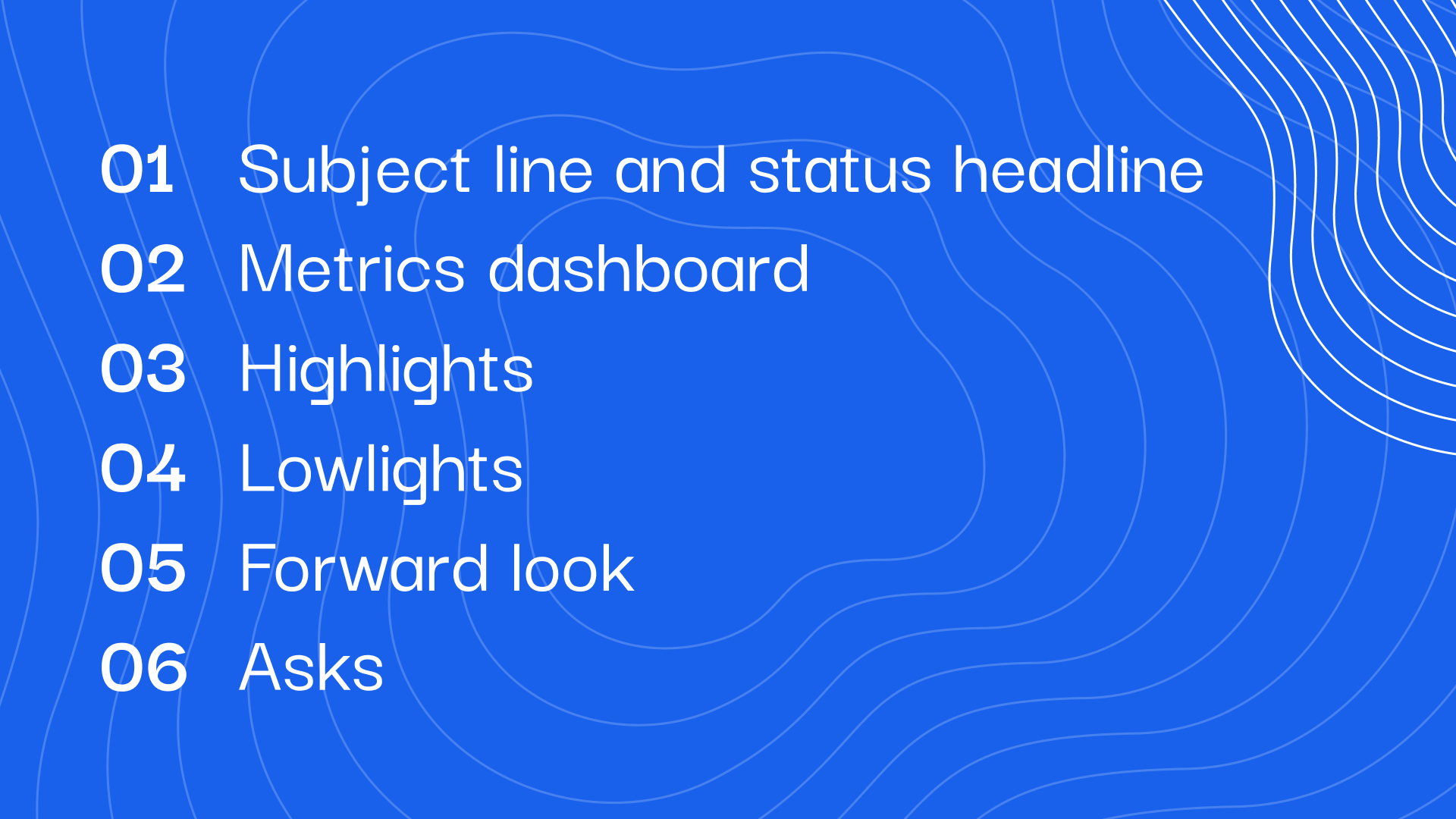
Every well-built investor update follows the same underlying structure. The company changes. The metrics evolve. The wins and misses rotate. The order and shape of the sections do not.
- 1Subject line and status headlineStandardized subject: "[Company] - [Month YYYY] Investor Update." Status headline is one sentence at the top of the email or document, stating whether the month was strong, mixed, or hard, and what the single most important fact is. If an investor reads only this sentence, they should know whether to be calm or concerned and roughly why.
- 2Metrics dashboardFour to six metrics that map to the stage of the business. Revenue or ARR, cash, runway, one to three leading indicators. Every metric shown with delta vs last period and delta vs plan. Same metrics every month, even when the number is unflattering. The trend line is the whole point.
- 3HighlightsTwo to four short bullets. What worked this month, named specifically enough to be credible. Not "product traction" but "closed three enterprise deals in healthcare vertical worth $210K in ARR."
- 4LowlightsSame visual weight as highlights. What did not work, why, and what the plan is. Not a footnote at the bottom. If your lowlights section is shorter than your highlights section every month, either your company is genuinely doing that well (rare), or you are hiding something (common). Investors notice.
- 5Forward lookTwo to three priorities for the next month. Not aspirational targets like "grow ARR 20 percent." Actual initiatives with owners: "Close VP Sales hire by month-end. Ship self-serve onboarding by the 20th. Sign the AWS partnership term sheet."
- 6AsksThree or fewer specific requests. Intros with the target described precisely enough to act on, feedback on a specific decision, help closing a hire, feedback on a specific piece of the roadmap. Vague asks ("would love intros!") get ignored. Specific asks get replied to.
Email vs Deck vs Notion: Format Follows Stage
The format debate is treated as personal preference across every guide in the SERP. It is not. Format follows stage. As the company matures, the update format shifts along a predictable path.
Pre-seed and seed: pure email
Under 300 words. All in the email body. No attachments, no linked decks, no charts. At this stage the reader is your seed investors and a handful of advisors, who want frequency over polish. Anything that adds friction (a downloaded PDF, a link to a slide deck, a paywalled platform) will not get opened by half your recipients. The signal you are sending is that you send regularly and stay in touch, not that you can produce a beautifully designed artifact.
Series A: email plus one KPI chart
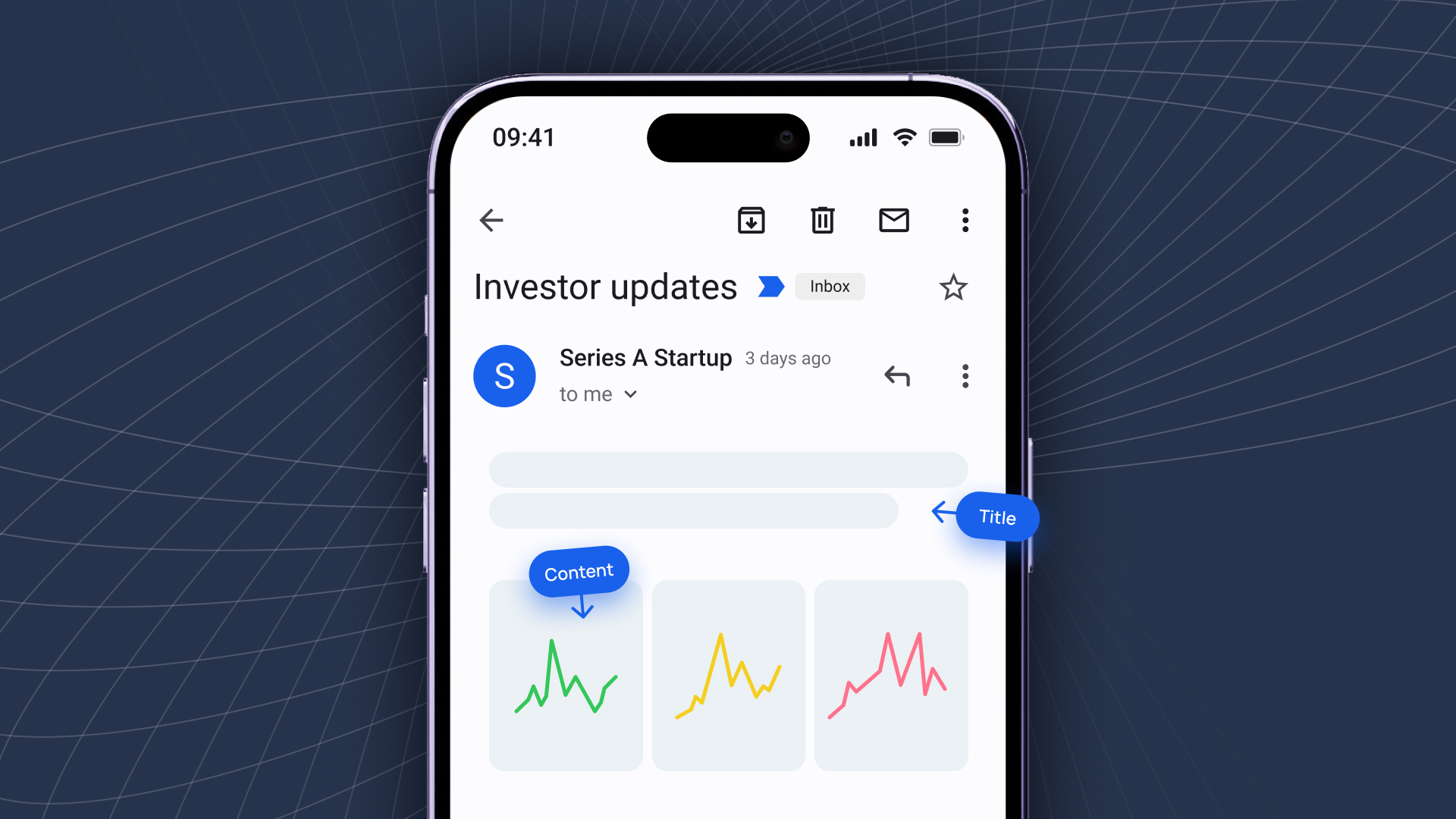
The transition point. Metrics matter more now, and one well-designed KPI chart embedded in the email body raises the signal-to-noise of the whole update. Still under 400 words. Still email-first. The chart shows the four to six standing metrics as either a compact table with color-coded deltas, or a small trend line over the last six months. The chart makes the numbers scannable in five seconds instead of thirty, which is the difference between an update that gets internalized and one that gets skimmed.
Series B: short deck plus email summary
The visual layer becomes structural. A five to eight slide deck (metrics, highlights, lowlights, forward look, asks, appendix) attached or linked, with a short email summary that lets investors skip the deck if they want. This is where consistent design across months starts to compound, because your investor list is now large enough that the format itself becomes part of the credibility signal. A polished, on-brand update in month twelve that looks identical in structure to the update in month one is evidence of operating discipline that pure prose cannot deliver.
Series C and beyond: full monthly narrative plus quarterly deck
Two artifacts working together. A monthly written update that keeps the operating rhythm visible between board meetings. A quarterly deck that drives the board meeting itself. Together they form a cadence system that most companies do not consciously design but that separates disciplined operators from the rest. The design of the monthly update at this stage matters even more, because your investor list now includes independents and strategic advisors whose only view of the company is what you send them.
The Design of the Update (Not Just the Words)
Design decisions on an investor update are not aesthetic. They are what separate an update that gets read carefully from one that gets skimmed and closed. Five choices do most of the work.
- 1Chart legibilityAny chart in an update needs a single-sentence takeaway above it, axes labeled at the same font size as the body text, and no more than one data story per chart. Same rule as a board deck, because the underlying principle is the same: a chart that needs the sender's narration to make sense is a chart that failed.
- 2Typography that reads on a phoneSixty percent of your investors will open the update on a phone, on a train, between meetings. Body text at 16px minimum. Line height at 1.5. No light grey text on white. No two-column layouts. The update has to survive being read on a five-inch screen with one hand.
- 3A locked visual templateSame header, same signature block, same metric table layout, same chart style, same color palette. Every month. When an investor opens month fifteen and it looks structurally identical to month one, that is the design system doing its job.
- 4Metrics table designFour columns: metric, current value, delta vs last period, delta vs plan. Deltas colored consistently across every update: green for on or above plan, amber for slightly off, red for materially off. Same coding, every month, even when the coding is unflattering.
- 5The signature blockFounder name, title, direct calendar link, direct email. Investors reply to some updates and not others; make it frictionless for the ones who do. A signature block that changes every month is a small tell that the update is not treated as recurring infrastructure.
The same discipline scales up to the boardroom. Our guide to chart design for board decks covers the claim-and-proof framework, the five chart types that cover most board data, and the mistakes that make directors lose trust in the numbers.
How Investor Updates Change by Stage
The six-section structure holds across stages. What changes is length, metric set, format, and investor list size.
Pre-seed and seed
Monthly cadence. Email format. Under 300 words. Metric set is small: revenue or GMV, cash, runway, one leading indicator. Investor list is small (five to fifteen recipients including advisors). Directness beats polish. The signal you are optimizing for at this stage is "the founder is still around, sending updates, still executing." That signal is delivered by frequency, not design.
Series A
Monthly cadence. Email plus one embedded KPI chart. Under 400 words. Metric set expands to include ARR growth, gross margin, CAC or CAC payback if the business is monetized. Investor list grows to twenty to forty. The single most important discipline at this stage: same metrics every month, even when a number goes sideways.
Series B
Monthly written plus quarterly deck cadence. Update covers ARR, NRR, magic number or burn multiple, hiring plan, and enterprise pipeline if applicable. Investor list is now large enough (forty plus) that consistency of format matters as much as content. The visual layer starts to compound as a trust signal in its own right.
Series C and beyond
Monthly narrative plus quarterly deck plus the annual strategic update. The monthly update becomes shorter (director attention is scarce), while the quarterly deck grows to run the full board meeting. Design consistency across all three artifacts becomes the differentiator between companies that operate at scale and companies that just happen to have scaled to that size.
The Common Mistakes That Kill Investor Updates
Every investor update mistake has the same root: the update is treated as an occasional task instead of recurring infrastructure. Six patterns show up again and again.
- 1Only sending updates when things are goodTrains investors to interpret silence as bad news. Fix: send every month regardless of the month. Especially the hard months.
- 2Different metrics every monthKills the trend line, which is the whole point of the update. Directors and investors either notice and lose trust, or do not notice and lose the signal. Fix: lock the metric set and rerun it monthly, even when a number is unflattering.
- 3Vague asks"We would love intros to interesting people" is not an ask. Fix: three specific asks maximum, each with enough detail to act on ("intros to VP Marketing candidates who have scaled a Series B SaaS from $10M to $50M ARR").
- 4No lowlights sectionReads as spin. Investors either stop reading carefully, or start asking harder questions to figure out what you are hiding. Fix: give lowlights equal visual weight to highlights, always.
- 5Too longNobody reads a 2,000-word update. Investors read the first paragraph, skim the metrics, and close. Fix: 250 words for monthly at seed, 400 at Series A, 500 at Series B.
- 6Format driftThe update looks different every month. Signals disorganization even when the underlying numbers are fine. Fix: a locked visual template that only changes with the annual brand refresh.
How to Systematize So You Never Skip a Month
Founders who never skip a month all built the same three things. Founders who skip months skipped one or more of them.
- 1Lock the template onceSame subject line format, same section order, same metrics table layout, same visual style, same signoff. The template stops being a decision and starts being a workflow. Every hour spent on template decisions in month twelve is an hour not spent on the numbers.
- 2Set a fixed send daySame day of the month, every month. First Monday, last Friday, or the 5th. Consistency is a signal of discipline in itself, and it forces the assembly process to become routine. Investors start expecting the update on that day, which creates the forcing function that a soft cadence never generates.
- 3Automate the metrics feedThe metrics table should pull from your BI tool or dashboard, not from someone manually re-typing numbers into an email every month. If you are re-typing numbers monthly, you are spending the wrong hours on the wrong work.
Most founders build one of the three, sometimes two. All three together is what separates the update that ships every month for five years from the one that limps along for eighteen months and quietly stops.
The investor update ships twelve times a year. Board decks ship four. That frequency multiplier is why the design system for updates has to be the tightest of any recurring artifact, and why bringing in a design partner to hold that system steady across sixty-plus sends is one of the higher-ROI decisions a growth-stage CoS or CEO's office can make.
Ship investor updates every month without redesigning them.
Slidecore designs the visual layer for growth-stage teams shipping investor updates and board decks on a recurring cadence. Locked template, refreshed content, 24-hour turnaround. See how we work with Chiefs of Staff, CEOs, and CFOs.
Frequently Asked Questions
Monthly is standard at seed and Series A. Quarterly is more common at Series B and beyond, often paired with the board deck cycle. The most important test is consistency, not frequency: twelve monthly sends per year on a fixed day will build more trust than an inconsistent mix that skips the hard months.
250 to 500 words for monthly updates, depending on stage. Under 300 words at pre-seed and seed. Under 400 at Series A. Under 500 at Series B. Quarterly updates can run longer (up to about 1,000 words) because they cover a broader period. Above 1,000 words for a monthly, you have stopped writing an update and started writing a report.
An investor update is a short-form recurring communication (usually email or a short document) sent to your investor list monthly or quarterly. A board deck is a long-form presentation (20 to 50 slides) that runs a formal board meeting quarterly. The update maintains operating trust between board meetings. The board deck runs the board meeting itself. Both artifacts work together in mature companies.
Format follows stage. Pre-seed and seed: pure email in the body, no attachments. Series A: email plus one embedded KPI chart. Series B: short deck (five to eight slides) plus an email summary. Series C: monthly written update plus a separate quarterly deck. The general rule is that adding friction (attachments, links, paywalls) reduces open rates, so the format should only get heavier when the added visual layer genuinely adds signal.
Four to six metrics that map to the stage of your business. At every stage: cash on hand, monthly burn, runway. Then two to three metrics that define your business - ARR growth, NRR, CAC payback, MRR, gross margin, active users, or whatever your investors are already tracking. Same metrics every month, shown with delta vs last period and delta vs plan.
Yes, always, with the same visual weight as highlights. An update with only wins gets read once and then gets skimmed forever after. An update that names misses honestly builds a compounding trust signal. Format: state the miss, diagnose the root cause in one sentence, name the specific plan to address it. Investors tolerate misses; they do not tolerate opacity.
In practice, the Chief of Staff or the CEO's office assembles and designs the update. The CEO writes the status headline, the highlights and lowlights framing, and the asks. This division scales; when the CEO tries to own the whole update end-to-end, monthly sends become the first thing that slips when the company gets busy.

Founder, Slidecore
Giorgi founded Slidecore to give teams a senior design partner for decks. His teams have designed 500+ decks for 100+ companies across SaaS, AI, fintech, and healthcare.
Meet the founder →Want decks like this for your team?
A design studio on subscription for every deck, report and keynote you ship.