Design Subscription vs In-House Designer: The Honest Math
The honest math on what an in-house designer really costs, what a subscription really covers, and why most growth-stage teams end up running both.
Every guide comparing a design subscription to hiring an in-house designer is written by a design subscription. This one is too. We run one. But the honest version of the design subscription vs in-house designer argument is not what most of those guides tell you. Once you have chosen the model, our top 10 deck design agencies and subscriptions roundup helps you shortlist specific partners.
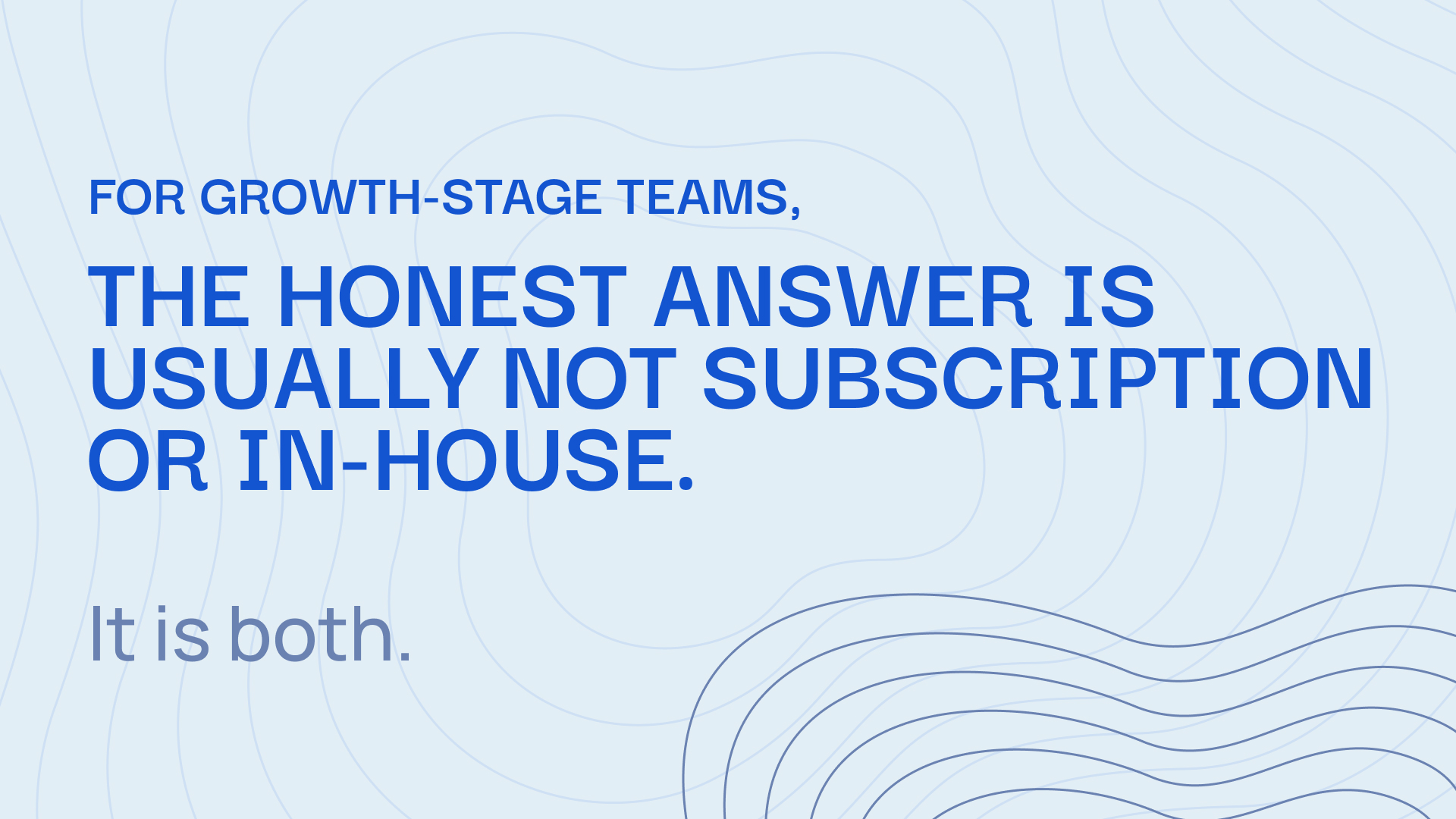
The honest version is: for most growth-stage and enterprise teams, the choice is not subscription OR in-house. It is a hybrid. An in-house designer or small team handles brand and product design, where the work is continuous and strategic. A subscription handles presentations, marketing collateral, and everything else that ships in spikes: board decks, investor updates, sales decks, launch campaigns.
The either/or framing makes sense when a company is choosing its first designer. Once past Series A, that framing usually fails, because both models exist inside real design orgs.
This guide walks the honest math. What an in-house designer actually costs, what a subscription actually covers, when in-house is genuinely the right call, when a subscription is genuinely the right call, when a freelancer is the right call, and when the answer is more than one. Then a decision framework to work out where your company actually sits.
Slidecore is a monthly design subscription for growth-stage and enterprise teams shipping recurring deck work. That is our vested interest in this argument. We will show the math both ways and tell you when in-house is the better call for the work you have.
What Each Option Actually Is
Four models get confused in this debate. Naming them clearly is the first step.
- 1In-house designerA full-time employee (or small team) on payroll. Reports into marketing, design, or the CEO's office depending on stage. Owns the design system, brand consistency, and the highest-priority strategic work. Costs like a full employee: salary, benefits, equipment, ramp time, management overhead.
- 2Design subscriptionA monthly recurring service that gives a company access to a design team, usually for a fixed fee, with defined turnaround times and scope. No hiring, no benefits, no ramp. Pause or cancel at month-end. Best for recurring or spiky work: decks, marketing collateral, sales materials, launch campaigns.
- 3FreelancerA single independent designer engaged on a project basis. Hourly or fixed-project pricing. Best for well-defined one-off work: a landing page, an event asset, a specific brand refresh. Poorly suited to recurring work at any real volume, because you are competing for their time against every other client they have.
- 4Design agencyA full agency engagement, typically retainer-based or project-based with account management overhead. Best for defining brand, running large campaigns, or executing multi-quarter design system projects. Rarely the right model for recurring deck work: too expensive per unit, too slow per round.
This guide focuses on the first two, because that is where most growth-stage debates actually land. Freelancer and agency come up at the margins. For the outsourced options, compare agency vs freelancer vs subscription.
How Much Does Each Option Actually Cost?
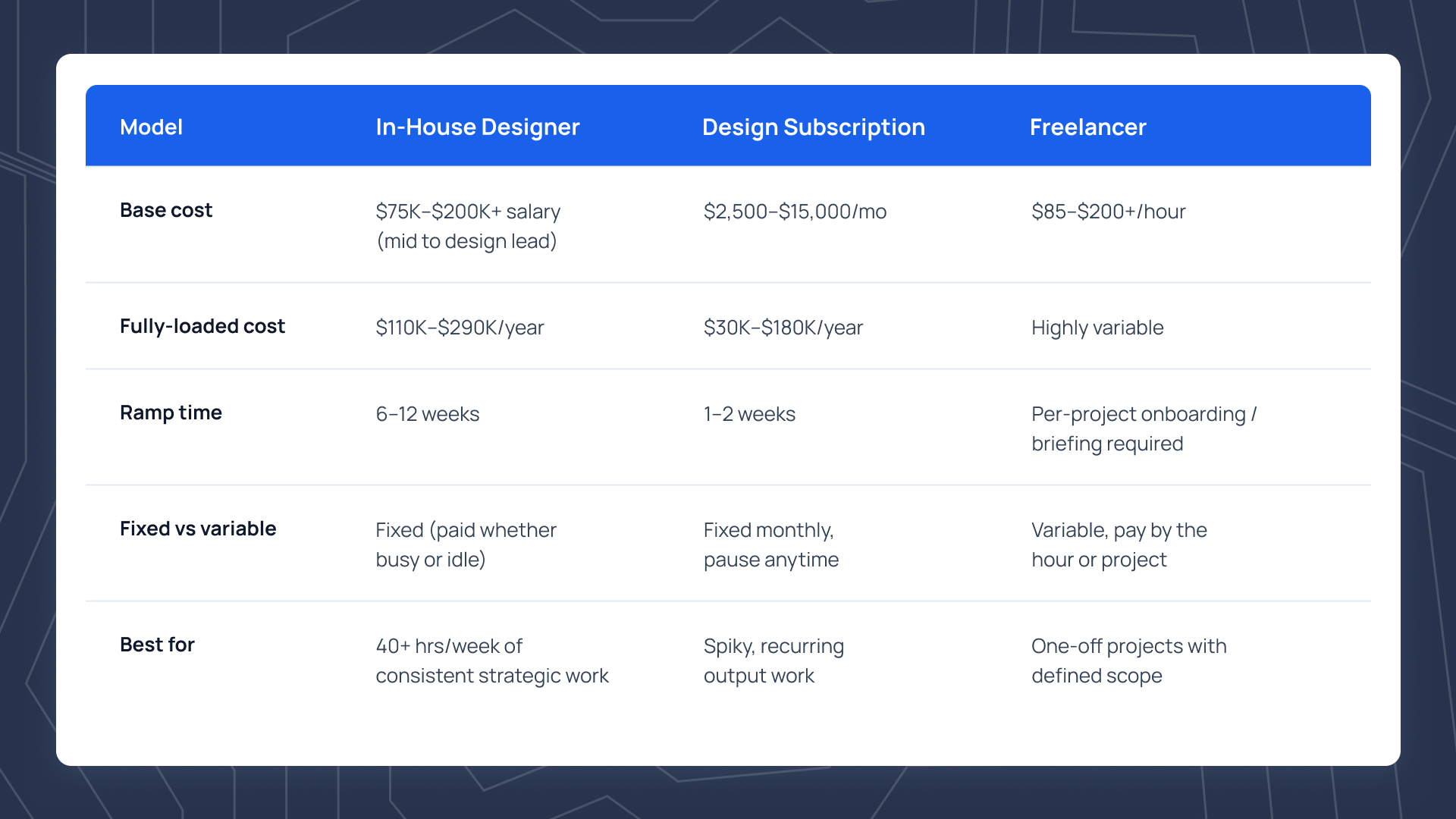
The salary listing is the smallest part of the number. Below is the honest all-in cost of each option for a growth-stage US company in 2026.
In-house designer, fully loaded
Base salary for a mid-level designer in the US: $75,000 to $110,000. Base for a senior designer with brand and motion experience: $115,000 to $170,000. Base for a design lead who can own a system across marketing and product: $150,000 to $200,000-plus.
That is the base. Add:
- Payroll taxes and benefits: 25 to 30 percent on top of base
- Equipment and software licenses (Figma, Adobe, hardware): $3,000 to $6,000 per year
- Recruiting cost (if using a recruiter): 20 to 25 percent of first-year salary
- Onboarding time before productive: 6 to 12 weeks of salary during ramp
- Management overhead: often 5 to 10 hours per week of a manager's time
All in, a single mid-level in-house designer costs a US company roughly $110,000 to $150,000 per year in year one. A senior designer runs $170,000 to $230,000. A design lead runs $220,000 to $290,000. Those numbers assume the designer stays. If they leave in year two, add the recruiting cost again and another ramp period.
Design subscription, fully loaded
Subscriptions run on tiered monthly pricing. The range across the market for growth-stage-quality work in 2026: $2,500 to $15,000 per month, depending on scope and turnaround. Slidecore's pricing sits inside this range.
That is roughly $30,000 to $180,000 per year. There are no payroll taxes, no benefits, no equipment costs, no recruiting fees, and no ramp period. Onboarding to a subscription typically takes one to two weeks, not one to two quarters.
The other cost most guides miss: management overhead. A subscription has some, but less than an in-house hire. A subscription is a delivery relationship, not a management relationship. In-house designers require career development, feedback loops, one-on-ones, and eventual promotion conversations. That management cost is real and lands on whoever the designer reports to, usually the CMO or Chief of Staff.
Freelancer, fully loaded
Rates for growth-stage-quality freelance designers in 2026 range from $85 to $200 per hour, depending on specialty and experience. For a company shipping design work at any real volume, freelancer costs get unpredictable fast: a single busy month can eclipse a subscription tier, a slow month costs nothing but you lose continuity of context.
The hidden cost of freelance at volume is context. Every new project starts with a re-briefing. The freelancer does not know your brand, your templates, your voice, or your usual reviewers. That re-briefing burden lands on the internal team, and at scale it is the reason most companies eventually move away from freelance-heavy models.
When In-House Wins
The most useful thing a design subscription can tell you is when to hire in-house instead. Five situations where in-house is the better call.
- 1You have 40+ hours per week of consistent design workThe math is simple. Once you have enough work to fill a full-time designer's week every week, the per-hour cost of a good in-house designer drops below a subscription. At forty hours per week of steady work, in-house is the right call.
- 2Brand and design system are strategicIf design is a core differentiator (consumer product, category-defining brand, product-led-growth motion), you need a designer who lives inside the company, understands the strategy, and owns the system across all touchpoints. That work does not outsource well.
- 3You need continuous product designProduct designers who understand your customers, your codebase, and your engineering team compound value over time in a way an external partner cannot. If you are building software, hire a product designer.
- 4You want the designer as a strategic partnerA senior in-house designer sits in strategy meetings, argues about roadmap, and influences product decisions. A subscription designer, however good, does not. If you want design at the leadership table, that means an in-house design lead.
- 5You can find and retain the right personThis is the underrated one. Design leads are hard to hire, and the ones you want have options. If you cannot compete for senior talent, an in-house hire will underdeliver even if the theoretical math works. In that case, a subscription with a senior designer on your account outperforms a mediocre in-house hire.
When a Subscription Wins
Five situations where a design subscription is the better call, even for companies that could afford an in-house hire.
Your design demand is spiky. Growth-stage teams almost universally have spiky design demand. Board deck week: 40+ hours of design work. The other three weeks of the quarter: 5 hours. A full-time hire is idle two-thirds of the quarter. A subscription flexes with the workload.
The work is recurring but not continuous. Board decks (quarterly), investor updates (monthly), sales decks (refreshed quarterly), QBR decks (quarterly), all-hands presentations (monthly). Each is recurring, but combined they still might not fill a full-time role. A subscription is built for this exact shape of demand.
You need multiple specialties at once. One in-house designer covers one skill set. A subscription usually covers presentation design, brand-consistent marketing collateral, light motion, chart design, and slide illustration under one contract. If you need range without hiring three specialists, a subscription is the cheaper answer.
You are pre-hire or between hires. Many Series A and Series B companies use a subscription for six to twelve months before hiring their first design lead. It buys time to figure out what the role actually looks like inside the company before committing to a full-time hire.
The work is presentation-heavy. Sales decks, board decks, investor updates, exec keynotes, marketing landing pages. Recurring, high-visibility work that needs consistent design quality. Most in-house designers hate doing "just presentations" and move on to product work at the first opportunity. A subscription that specialises in presentation and marketing design does this work well because it is what they exist to do.
When a Freelancer Wins
The freelancer model is right for a narrower band of situations than the SERP suggests. Three cases where it is genuinely the best call.
- 1The project is one-off and well-definedA landing page redesign. An event asset. A specific illustration. Anything you can hand off with a clean brief, get back complete, and never think about again. Freelancers are good at bounded projects.
- 2You need a specialist for a specific assetA world-class type designer for a wordmark. A senior motion designer for a launch video. A specialist illustrator for a specific style. Freelance is how you access the top of the market for narrow specialties that would not fill a full-time role.
- 3Your total design work is under five hours a monthBelow a threshold, a subscription is overkill. Very early-stage companies with occasional design needs are better served by a good freelancer they trust.
When freelance starts to fail: recurring work at any real volume, brand consistency across many touchpoints, and any situation where losing the freelancer to a competing client would break your workflow.
The Hybrid Model (Which Is What Most Growth-Stage Companies Actually Run)
This is the section that no ranking page covers. Most growth-stage and enterprise companies do not choose between in-house and subscription. They run both. Understanding why is the point of this guide.
The typical growth-stage design org, once headcount has been thought through, splits like this. In-house: one to three designers, usually a design lead plus a product designer plus a brand or marketing designer. They own the design system, the product surface, the brand, and the highest-visibility marketing work. Subscription: one active partner, handling the recurring deck work, the marketing collateral that ships in spikes, and any overflow from the in-house team during crunch periods.
This split works because the two models are good at different things. In-house designers, especially senior ones, build compounding value through context: they know the brand, the customers, the product, the exec team. That context is expensive to build and expensive to lose. A subscription, by contrast, is good at throughput on well-defined work with a locked template. It is the wrong tool for defining the brand and the right tool for expressing the brand across a hundred deliverables a year.
The mistake is asking the in-house designer to do both. When a design lead is spending 60 percent of their time updating quarterly board decks and refreshing sales collateral, they are underused. Their strategic influence disappears, they burn out, and they leave. A subscription absorbs the recurring work so the in-house team can do the work that only in-house can do.
A Decision Framework: Which Do You Need?
Three questions to work through, in order.
- 1How much design work do you actually have per week?Not "how much do we wish we had?" but "how much would we actually brief in?" Track the volume for a month. Under 10 hours per week: subscription or freelancer. Between 10 and 30 hours: subscription is almost always right. Between 30 and 40 hours: the math starts to converge. Over 40 hours of consistent work: hire in-house.
- 2How spiky is the work?If demand runs 40 hours one week and 5 the next, you are dealing with spiky demand. A full-time hire will be idle half the time. Even at 40 hours average, the spikiness itself is a reason to prefer a subscription over a hire. Subscriptions absorb variance. Full-time hires do not.
- 3Is the work strategic, or is it output?Strategic: brand definition, design system architecture, product design that shapes user behaviour, category-defining marketing. Output: presentations, collateral, launch assets, sales enablement materials. Strategic work needs an in-house owner. Output work is better handled by a subscription that specialises in it.
If you scored high on volume, low on spikiness, and high on strategic work, hire in-house. If you scored high on spikiness, mixed on volume, and mostly output work, subscribe. If you scored high on both types of work, run both.
The Common Mistakes That Waste Design Budget
Six patterns to avoid, from the many growth-stage companies that have gotten this decision wrong.
- 1Hiring too earlyCompanies at Series A often hire a design lead because "we need design" without checking whether they actually have forty hours of strategic design work per week. The hire ends up doing tactical work, gets frustrated, and leaves. Fix: subscribe first, hire when the actual workload proves out the role.
- 2Hiring too lateCompanies past Series B hold off on hiring a design lead because "the subscription is working fine." Meanwhile the brand is drifting and no one is thinking strategically about design. Fix: once brand and product become strategic differentiators, an in-house owner is non-negotiable.
- 3Asking an in-house designer to do everythingDesign lead spends the first half of every week on quarterly board decks and the second half on strategic work. Strategic work never actually happens. Fix: offload the recurring deck cadence to a subscription and give the in-house designer their week back.
- 4Choosing a subscription too small for the workSigning up for a $500 per month plan and then complaining that the throughput is not enough for a Series B workload. Fix: match the subscription tier to the actual scope, and expect enterprise-grade subscriptions to sit in the $5K to $15K per month range.
- 5Using freelancers for recurring workEvery project starts with a re-brief. The freelancer never gets deep in your brand. The work looks slightly different every time. Fix: use freelancers for one-off work only. Recurring work goes to a subscription or in-house.
- 6Treating design as a cost line, not a leverage lineDesign decisions on board decks, investor updates, sales decks, and product surface compound into real business outcomes. Fix: benchmark your total design spend as a percentage of revenue, not as a dollar figure.
What to Expect From a Good Design Subscription
If you decide a subscription is the right call, six things separate the good ones from the bad ones.
- Senior designers on your account, not junior designers doing template swaps.
- Locked template ownership, holding the line on brand consistency across every deck they ship.
- Turnaround under 72 hours for standard work. Growth-stage teams need 24 to 72 hours, not agency-style timelines.
- A named point of contact, not a ticket queue.
- Direct communication in Slack, Notion, or their platform. Email-only workflows are a red flag.
- Pause and cancel flexibility, with a monthly commitment maximum.
If a subscription is your answer, here is how Slidecore works.
Monthly subscription. Senior designers on your account. Locked template, 24-hour turnaround per deck, direct communication, pause anytime. Built for growth-stage and enterprise teams shipping board decks, investor updates, sales decks, and marketing collateral on a recurring cadence.
Frequently Asked Questions
For most growth-stage companies, yes. A mid-level in-house designer costs $110,000 to $150,000 per year fully loaded. A subscription runs $30,000 to $180,000 per year depending on scope. But cost is not the whole answer. The right question is whether you have 40 or more hours of consistent design work per week. If yes, hire. If no, subscribe.
When you have 40 or more hours per week of consistent design work AND at least half of it is strategic (brand, design system, product design, category-defining marketing). If either condition is not met, subscribe or use freelance for another quarter or two and check again.
No. A subscription is a capacity multiplier, not a strategic leader. If you need design at the leadership table, arguing about roadmap and shaping product decisions, you need an in-house design lead. The subscription runs the output work so the design lead can focus on strategy.
For growth-stage-quality work in 2026, subscriptions range from about $2,500 to $15,000 per month. Below $2,500, you are usually getting junior designers or template-swap work. Above $15,000, you are typically paying for agency-style overhead.
For one-off projects, yes. For recurring work at any real volume, no. Every freelance project starts with a re-brief, which puts the internal team back in the position of writing detailed briefs every time. A subscription builds context over months and delivers faster because they already know your brand, template, and reviewer preferences.
Track the actual hours briefed to design (in-house, subscription, or freelance) for one month. If the number is under 40 hours per week averaged over the month, hiring will not pay back. Between 40 and 60 hours, hire is likely the right call. Over 60 hours, hire and consider a subscription for overflow.
Yes, and most growth-stage companies eventually do. The in-house designer or design lead owns the design system, brand, and product surface. The subscription handles recurring output work (decks, updates, collateral, launch assets). This hybrid model is more common than either extreme at Series B and above.

Founder, Slidecore
Giorgi founded Slidecore to give teams a senior design partner for decks. His teams have designed 500+ decks for 100+ companies across SaaS, AI, fintech, and healthcare.
Meet the founder →Want decks like this for your team?
A design studio on subscription for every deck, report and keynote you ship.